
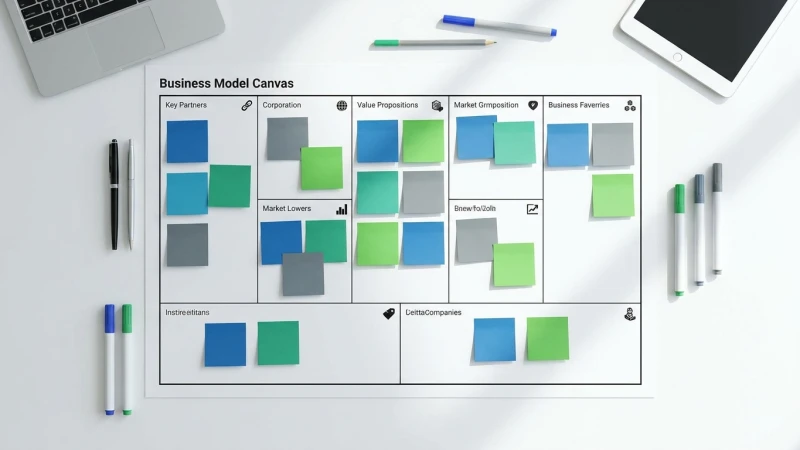
73% of business model canvases end up as wall decorations rather than strategic tools. This isn’t just a statistic; it’s a reality many B2B founders and executives face. You might painstakingly plot your business on a canvas only to find it gathering dust. The good news? In this business model canvas guide, you’ll learn how to turn your canvas into a decision-driving, profitability-validating tool. We’ll dive deep into why most canvases fail, how to avoid common pitfalls, and how to validate each block with real customer data. You’ll walk away with a strategic edge that turns theory into practice. Ready to become part of the 27% who make it count? Let’s dive in.
Why 73% of Business Model Canvases Fail (And How to Be in the 27%)
Most business model canvases (BMCs) fall short because they remain untested theoretical constructs. A Harvard study revealed that flawed assumptions and lack of validation cause 73% of business models to fail. Why? Because they often don’t address real customer needs or market dynamics.
Let’s consider the top five validation mistakes that founders make:
- No real customer engagement before finalizing the canvas.
- Over-reliance on assumptions without data-backed validation.
- Ignoring inter-block dependencies.
- Failure to iterate based on customer feedback.
- Inadequate market research and competitive analysis.
The difference between theoretical and practical BMCs is stark. Theoretical models make assumptions, while practical ones are tested, iterated, and validated with data. The best approach is to embed validation directly into your canvas design process.
|
Mistake |
Percentage of Failures |
|
No Customer Engagement |
29% |
|
Assumption-Based |
22% |
|
Ignored Dependencies |
15% |
|
No Iteration |
18% |
|
Poor Market Research |
16% |
For more insights on strategic planning, check out our B2B Strategic Planning: 7-Step Framework for 12% Revenue Growth.
The 9 Building Blocks of the Business Model Canvas Explained
Understanding the nine building blocks of the BMC is important, but to surpass competitors, you’ll need to validate each one. These blocks interconnect, change in one affects the others. Here’s a detailed look at each element:
- Customer Segments: Identify distinct groups of people your business aims to serve. Validation question: Have you engaged with a representative sample of your segment?
- Value Propositions: Why customers should buy from you. Validation question: Have you tested and quantified your propositions with real users?
- Channels: How you deliver your value proposition. Validation question: Do your channels align with customer preferences and behaviors?
- Customer Relationships: How you gain, keep, and grow customers. Validation question: Have you tested different relationship methods for effectiveness?
- Revenue Streams: The money you earn from each customer segment. Validation question: Are your pricing models aligned with market standards and customer willingness to pay?
- Key Resources: Assets required to offer and deliver your propositions. Validation question: Have you identified and secured all necessary resources?
- Key Activities: Activities required to deliver your value proposition. Validation question: Are your activities simplify and efficient?
- Key Partnerships: External companies or individuals you need to perform your key activities. Validation question: Are your partnerships mutually beneficial and strategically aligned?
- Cost Structure: All costs incurred to operate your business model. Validation question: Have you improve your cost structure to support your revenue streams?
Customer Segments: Beyond Demographics to Buying Behavior
In the realm of B2B, customer segmentation goes deeper than mere demographics. The key is to understand the jobs-to-be-done framework, which shifts focus from products to customer needs and buying behaviors. B2B differs significantly from B2C, demanding a more intricate analysis of needs, pain points, and desired outcomes.
A strong customer segment validation framework includes:
- Conducting interviews with a cross-section of potential and existing customers.
- use surveys to quantify segment challenges and preferences.
- Analyzing purchase data to identify trends and behaviors.
For a complete guide on crafting effective customer personas, see our resource on managing entrepreneurial stress through targeted customer insights.
Value Propositions That Actually Convert: The Canvas Connection
How do you create value propositions that resonate and convert? By integrating the Value Proposition Canvas with your BMC. This isn’t just about crafting a catchphrase. It’s about aligning your propositions with customer pain points and desired gains.
Here’s how to test your value propositions effectively:
- Pain-Gain-Job Fit: Map out customer pains, gains, and jobs, and ensure your solutions directly address these needs.
- Quantification: Use metrics to assess the impact of your propositions. What percentage of customers report satisfaction?
- Iteration: Use A/B testing to refine value propositions based on customer feedback and results.
For more on how to integrate these insights into a strategic advantage, explore our competitive analysis frameworks.
Revenue Streams and Pricing Models: The B2B Playbook
B2B revenue models are not one-size-fits-all. Whether you’re dealing with SaaS, services, or products, each demands a distinct revenue approach. Understanding pricing psychology is critical. It’s not just about setting a price; it’s about understanding perceived value.
Consider these revenue stream validation metrics:
- SaaS Models: Focus on customer lifetime value (CLTV) and churn rates.
- Service-Based Models: Measure client acquisition cost (CAC) and contract renewal rates.
- Product Models: Analyze margins and competitive pricing benchmarks.
For an in-depth exploration of pricing strategies, read our guide on B2B marketing strategies during economic downturns.
Key Partnerships: Strategic Alliances That Scale Your Model
Strategic partnerships are the backbone of flexible business models. The right alliances can multiply your reach and capabilities. But how do you evaluate and manage these partnerships for the best results?
Here’s a partnership evaluation matrix:
- Strategic Value: Does the partnership improve your core capabilities?
- Alignment: Are your goals and values aligned with your partner’s?
- ROI Measurement: Do you have systems in place to measure the partnership’s ROI?
For advice on integrating partners into your BMC, see the Bootstrapping vs VC funding guide.
Step-by-Step BMC Workshop: From Blank Canvas to Validated Model
Creating a functional BMC requires more than filling in boxes. Whether you’re working solo in a 30-minute sprint or help a 2-hour team workshop, structure and facilitation are key to success. Here’s how to do it:
Solo 30-Minute Sprint:
- Set a timer for 5 minutes per block.
- Focus on not overthinking; jot down initial thoughts quickly.
- Review and mark areas needing further validation.
2-Hour Team Workshop:
- Start with a brief overview of the BMC and its purpose.
- Assign each block to a different team member for deeper exploration.
- Include a facilitator to guide discussions and maintain focus.
Avoid common derailments like excessive debates or going off-topic by sticking to a structured agenda.
For a checklist to ensure a successful workshop, consult our RPA implementation guide.
Validating Your Business Model Canvas: Data-Driven Iteration
Validation is where most BMCs drop the ball. Use data-driven iteration to refine your model. Here’s how:
Hypothesis Testing: Formulate hypotheses for each block and test them using real-world data.
Validation metrics include:
- Customer feedback scores
- Sales conversion rates
- Operational efficiency metrics
When should you pivot? Use a decision tree to assess whether it’s time to stick or twist.
For more on strategic pivoting, read about business model innovation.
Real BMC Examples: 3 Companies That Pivoted Successfully
Understanding theory is one thing, but seeing it in practice is another. Let’s look at three companies that successfully pivoted:
Company A: Initially a SaaS platform, pivoted to a hybrid service model after testing revealed higher service demand.
Company B: Shifted from direct sales to channel partnerships, leading to a 50% increase in customer acquisition.
Company C: Refocused on a niche market segment after initial broad targeting proved unsustainable.
For more case studies on pivoting, see our B2B Accelerator Programs article.
BMC Tools and Templates: Your Strategic Toolkit
Having the right tools can make or break your BMC creation process. Here’s what you need:
Digital vs Physical Canvases: Digital canvases offer easy collaboration, while physical versions encourage in-person brainstorming.
Integration: Ensure your BMC tool integrates with other strategic tools you use.
Customization: Choose templates that allow for industry-specific adjustments.
Download customizable templates from our Resources Archive.
Conclusion: Build a Business Model Canvas That Really Works
Turning your business model canvas into a strategic powerhouse is about validation, iteration, and real-world testing. Don’t let your BMC become a relic; instead, use it as a living document that evolves with your business. Your next step? Start by engaging directly with customers to validate your first block today.
For more insights and strategies on effective business planning, explore our Blogs and resources.
What is a business model canvas? A business model canvas is a strategic management tool used to visualize the fundamental elements of a business or product. It consists of nine blocks that cover key aspects like customer segments, value propositions, and revenue streams. This tool helps in brainstorming and structuring business ideas. How to fill out a business model canvas? Start by identifying and defining each block: customer segments, value propositions, channels, customer relationships, revenue streams, key resources, key activities, key partnerships, and cost structure. Engage with decision-makers and use data to fill each segment accurately. What’s the difference between business model canvas and value proposition canvas? The business model canvas provides a complete overview of the business structure, while the value proposition canvas focuses specifically on the relationship between customer needs and the product or service offering. Both work together to refine business strategies. How long does it take to complete a business model canvas? Depending on the complexity of the business and depth of data, it can take anywhere from a few hours to several days. It’s an iterative process that involves brainstorming, data analysis, and decision-makers input. Can business model canvas be used for existing businesses? Absolutely. The business model canvas is an excellent tool for existing businesses to reassess and realign their strategies, especially when considering expansion, pivoting, or introducing new products. It provides clarity and strategic direction.