
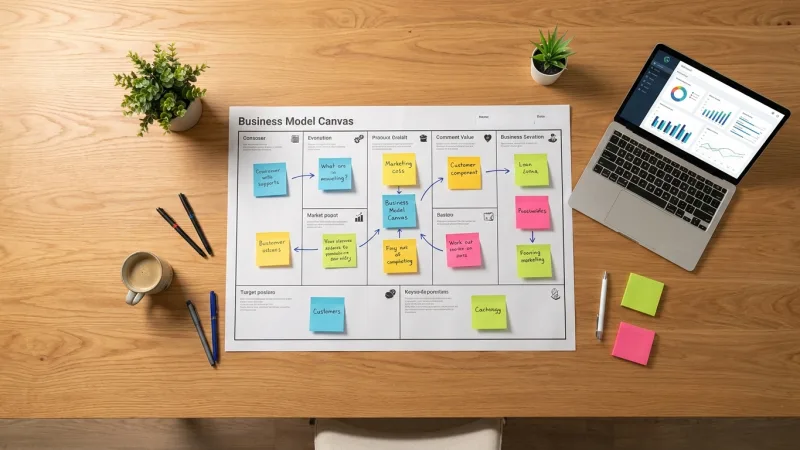
Imagine crafting a product for months only to discover nobody wants it. Harsh reality? Perhaps, but it’s the fate of 70% of startups that falter due to unvalidated business models. The businesses that succeed have a secret weapon: the Business Model Canvas (BMC). This single-page tool helps founders map and validate their entire business model before they even begin development. In this article, you’ll learn to use the business model canvas guide to validate each element with real data, preventing costly missteps.
Why 70% of Business Models Fail (And How the Canvas Prevents This)
Startups don’t fail because of bad ideas. They fail because they create products people don’t need. According to CB Insights, 42% of startups cite misreading market demand as the top reason for failure. Using the Business Model Canvas can prevent this by allowing you to validate assumptions early.
Consider the cost of pivoting: it’s significantly cheaper when done early. Companies that pivot early save up to 30% of budgeted expenses compared to those that pivot later. A validation-first approach ensures you’re building on a foundation of real customer data rather than assumptions.
|
Scenario |
Average Cost of Pivoting |
|
Late-stage Pivot |
$150,000 |
|
Early-stage Pivot |
$45,000 |
Using the Business Model Canvas doesn’t just mitigate risks; it change your entire approach to building a business. You shift focus from assumptions to data-driven decisions, which is important for long-term success. Explore our detailed 60-minute BMC sprint framework to get started.
Business Model Canvas Fundamentals: The 9 Building Blocks Decoded
At its core, the Business Model Canvas consists of nine building blocks that map out the critical aspects of your business. Understanding these blocks is important. Let’s break them down:
- Customer Segments: Who are your customers?
- Value Propositions: Why do customers choose you?
- Channels: How do you reach your customers?
- Customer Relationships: How do you maintain customer interactions?
- Revenue Streams: How does your business earn money?
- Key Resources: What assets are indispensable?
- Key Activities: What are the important actions?
- Key Partnerships: Who are your important partners?
- Cost Structure: What are your major expenses?
Each block interconnects, painting a complete picture of your business model. Neglecting interdependencies can lead to misalignment. For example, a change in the Customer Segments block impacts your Revenue Streams and Value Propositions. The importance of understanding these links can’t be overstated. Dive deeper into the specifics with our detailed guide.
|
Block |
Interdependency |
|
Customer Segments |
Influences Value Propositions, Revenue Streams |
|
Key Partnerships |
Affects Cost Structure, Key Activities |
The Data-Driven Canvas: How to Validate Each Block Before You Build
Validation is the secret sauce of a successful business model. Before committing resources, each canvas block should be backed by data. Here’s how:
- Customer Segments: Use surveys and interviews to confirm their needs.
- Value Propositions: Conduct A/B tests and gather user feedback regularly.
- Channels: Analyze conversion rates within your sales funnels.
- Customer Relationships: Measure engagement levels through CRM tools.
- Revenue Streams: Pilot pricing strategies with early adopters.
- Key Resources: Inventory checks ensure you have necessary resources.
- Key Activities: Process mapping identifies efficiency opportunities.
- Key Partnerships: Evaluate potential partner ROI through case studies.
- Cost Structure: Track expense ratios and conduct cost-benefit analyses.
It’s important to set minimum viable validation criteria for each block. If a block doesn’t meet these criteria, it signals red flags needing immediate attention. Implementing a validation framework ensures you’re on the right track.
Customer Segments: Beyond Demographics to Behavioral Segmentation
Understanding who buys your product is pivotal. Yet, traditional demographic segmentation can be misleading. Behavioral segmentation, however, provides a clearer picture of customer needs and motivations. Consider the Jobs-to-be-Done framework, which focuses on what customers aim to achieve.
For B2B, mapping the buying committee is important. Typically, this includes users, influencers, and decision-makers. Understanding each persona’s role aids in crafting targeted strategies. Use our B2B persona framework to refine your approach.
|
Behavioral Segment |
Key Characteristics |
|
Task-oriented Buyers |
Focus on efficiency and effectiveness |
|
Value-driven Buyers |
Seek cost savings and value propositions |
Prioritizing segments is critical. A matrix scoring each segment by size, growth potential, and strategic fit can guide resource allocation effectively. Our segment scoring template is designed to simplify this process.
Value Proposition Design: The Canvas Within the Canvas
Your Value Proposition must resonate with your customer segments. Here, the Value Proposition Canvas proves invaluable, fitting neatly within the broader BMC framework. It sharpens focus on customer pains, gains, and the solutions your product offers.
Testing your value proposition is non-negotiable. Conduct surveys and use product demos to gather data on customer reaction and perception. This feedback loop informs necessary adjustments to align better with market needs, avoiding the fate of the 70% who fail.
Competitive differentiation also plays a role. What makes your offer stand out? Incorporate unique selling points and monitor their impact. The pain-gain analysis template can aid in evaluating this alignment.
Revenue Model Architecture: 7 Proven B2B Monetization Strategies
Choosing the right revenue model is as critical as your product itself. Whether it’s SaaS, services, or traditional product sales, understanding what aligns best with your business and customer base is important.
|
Model Type |
Description |
|
SaaS |
Recurring revenue streams through subscriptions |
|
Service |
Revenue from providing specialized services |
Integrating pricing strategy into your revenue model is critical for success. A structured decision tree that considers customer value perception, market standards, and cost inputs ensures you’re not undervaluing your offer. Explore our pricing strategy decision tree to refine your revenue models.
Predictability in revenue is another factor, influenced by contract lengths, customer stickiness, and market conditions. Our guide on business model innovation offers insights on maintaining adaptability.
Step-by-Step Canvas Creation: The 60-Minute Workshop Method
Turn planning into action with our tactical 60-minute workshop method. This approach is designed for swift yet complete business model mapping.
Begin with a clear agenda: introduction (10 minutes), customer segments (10 minutes), channels (10 minutes), and so forth. Facilitation is key. Encourage open dialogue and collaborative brainstorming to draw out various perspectives.
Beware of common pitfalls: scope creep, lack of focus, and groupthink. By following our structured workshop timeline, you can sidestep these challenges, ensuring a productive session.
Canvas Evolution: When and How to Pivot Your Business Model
Success often means adapting to change. Indicators like declining customer engagement or new market opportunities suggest it’s time to pivot your business model. Identifying these early allows for strategic, rather than reactive, changes.
A versioning system for your canvas is important. Track alterations to ensure clarity and alignment among decision-makers. This system supports effective communication and smooth transitions. Use our pivot decision framework for guidance.
Clear communication during pivots prevents confusion and maintains morale. Regular updates aligned with strategic pivots keep the team focused and motivated. Learn more about decision-makers engagement with our resources archive.
Digital Tools and Templates: BMC Software Comparison Guide
Mapping your business model digitally offers benefits like real-time collaboration and integration. When choosing between free and paid tools, consider factors like integration capabilities and user interface.
|
Tool |
Feature Summary |
|
Canva |
Easy-to-use and free templates, limited integration |
|
Lucidchart |
Advanced features with extensive integration possibilities |
Effective collaboration features are non-negotiable. Look for tools that support multiple user inputs and comments. Download links for templates are available in our resources archive.
Conclusion
Ready to change your business planning? Start by mapping out your business model using the Business Model Canvas today. It’s a practical step toward strategic clarity and success. For additional insights, explore our articles on RPA implementation and strategic planning. As markets evolve, those equipped with validated models will lead the charge in innovation and growth.
What is a business model canvas? A business model canvas is a strategic management tool that enables you to visualize and assess your business model. It’s a single-page document that outlines all critical aspects of a business, aiding in both analysis and planning through its nine core components. How to fill out a business model canvas? Begin by understanding each of the nine key components: Customer Segments, Value Propositions, Channels, Customer Relationships, Revenue Streams, Key Resources, Key Activities, Key Partnerships, and Cost Structure. Use data and brainstorming to detail each section, ensuring that they all align strategically. How long does it take to complete a business model canvas? Typically, a detailed business model canvas can be completed in a focused 60-minute session. This requires preparation and a clear agenda, involving key decision-makers to ensure complete coverage and strategic alignment. What’s the difference between a business model canvas and a business plan? A business model canvas is a concise, visual summary of a business model, while a business plan is a detailed written document. The canvas offers a snapshot for quick analysis, whereas the business plan provides in-depth strategies and forecasts. Can you use a business model canvas for existing businesses? Yes, the business model canvas is a valuable tool for existing businesses. It aids in assessing current operations, exploring new opportunities, and re-aligning strategies with market changes, providing a flexible framework for ongoing innovation.