
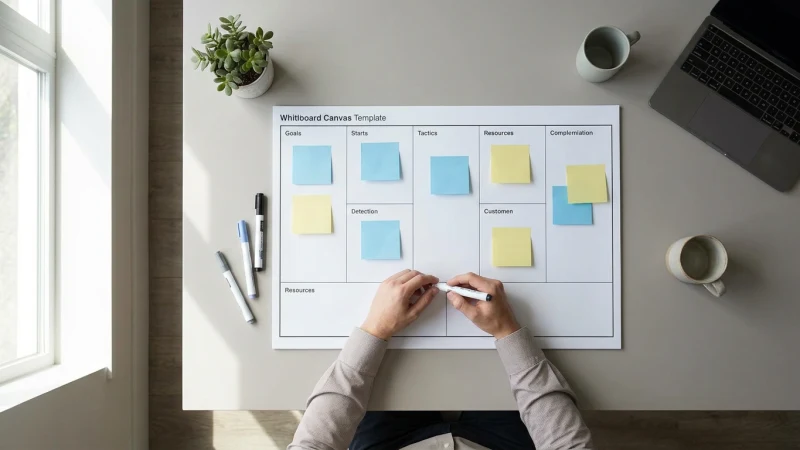
90% of startups fail not because of bad products, but because of flawed business models. Imagine putting all your strategic decisions on a single page, creating a bird’s-eye view that helps you identify potential pitfalls before they become disasters. This article will walk you through the complete Business Model Canvas guide, giving you a 5-step framework to validate your assumptions, integrate advanced techniques, and even pivot your business model successfully. By the end, you’ll have practical insights to cut your strategic planning time in half, no more endless revisions or guesswork. Let’s dive into why the Business Model Canvas is a must-have tool for B2B companies.
What is the Business Model Canvas and Why B2B Companies Need It
The Business Model Canvas, created by Alexander Osterwalder, is a strategic management template that allows you to visualize, design, and innovate your business model on a single page. It’s a favorite for B2B companies because it simplifies complex business plans, focusing on nine critical components that provide a complete overview of the business.
Statistics show that 42% of businesses don’t succeed because the market doesn’t need their product. But let’s face it, the real culprit is often a lack of strategic planning. The Business Model Canvas saves time by simplify this process, giving you a clear view to align your business strategies with customer needs.
| Traditional Business Plan | Business Model Canvas |
| 50+ pages, time-consuming | 1 page, time-efficient |
| Detailed, often inflexible | Visual, easily adaptable |
| Focus on documentation | Focus on strategy and execution |
For B2B companies, the Business Model Canvas addresses unique challenges such as longer sales cycles and complex decision-making processes. It’s not just a planning tool; it’s a strategic advantage. Learn how to map your B2B strategy on one page with our Business Model Canvas: Map Your B2B Strategy on 1 Page guide.
The 9 Building Blocks of the Business Model Canvas Explained
Understanding the nine building blocks of the Business Model Canvas is important. Each block interconnects, forming a complete picture of your business model. Let’s break them down with B2B-specific examples.
- Customer Segments: Identify your target clients and their needs. B2B companies often deal with multiple decision-makers; segment clearly to tailor your approach.
- Value Propositions: Define what sets you apart. How does your solution address specific pain points, and what gains do you offer?
- Channels: Outline how you reach your customers. For B2B, this often includes direct sales teams and strategic partnerships.
- Customer Relationships: Determine how you’ll acquire and retain customers. Consider CRM systems and account-based marketing for personalization.
- Revenue Streams: Identify your income sources. Subscription models and long-term contracts are prevalent in B2B settings.
- Key Resources: Inventory the important assets required to deliver your value proposition. This might include a talented sales team or proprietary technology.
- Key Activities: List the critical actions needed to achieve your business goals. Think product development or customer support.
- Key Partnerships: Identify alliances that complement your strengths. For example, tech firms often partner with integrators to expand reach.
- Cost Structure: Analyze your costs to ensure profitability. This includes fixed and variable expenses, such as R&D and marketing.
Consider a SaaS company: its customer segments may include SMEs, its value proposition could focus on time-saving software, and its key resources likely involve cloud infrastructure. Learn more in our Business Model Canvas: 9-Block Framework for Execution guide.
Step-by-Step Guide: How to Fill Out Your Business Model Canvas
Filling out your Business Model Canvas might seem daunting, but by following a structured approach, you can efficiently outline your business strategy.
- Start with Customer Segments: Consider who benefits from your product and tailor your approach accordingly.
- Move to Value Propositions: Ask, “What unique value do we provide to each customer segment?”
- Identify Channels: Determine how customers want to be reached.
- Define Customer Relationships: Think about how to maintain these connections.
- Explore Revenue Streams: Be clear on how each segment pays you.
- List Key Resources: Identify what you need to deliver your value proposition effectively.
- Specify Key Activities: Consider what actions are important to your business model.
- Recognize Key Partnerships: List external companies that support your strategy.
- Outline Cost Structure: Determine your main costs and strategize to minimize these.
As you fill out your canvas, ask targeted questions for each block. For instance, under ‘Channels’, ask, “Which channels work best for customer acquisition and retention?” This method ensures that you cover all bases effectively. Check out our Business Model Canvas Guide: Map 9 Key Blocks in 1-3 Hours for more details.
Advanced BMC Techniques: Value Proposition Canvas Integration
To improve your Business Model Canvas, integrate the Value Proposition Canvas. This advanced technique allows you to dive deeper into customer needs, perfect for complex B2B environments.
Start with a jobs-to-be-done framework, identifying what your customer is trying to accomplish. Map these jobs to your product’s features, focusing on pain points and gain creators. This integration ensures that your value propositions are not only aligned with customer needs but also differentiated in the market.
For example, a consulting firm can use this technique to tailor solutions that specifically address their clients’ operational inefficiencies, thus creating a compelling value proposition. Our Business Model Canvas: 9-Block Framework for Startups offers more insights on integrating these techniques.
Business Model Canvas Validation and Testing Framework
Creating assumptions without validation is risky. To ensure your Business Model Canvas reflects reality, establish a validation and testing framework.
Start by identifying core assumptions. Use hypothesis testing and customer validation methods, such as surveys and interviews, to gather feedback. Set clear metrics and timelines for these tests.
| Testing Phase | Timeline | Metrics |
| Customer Interviews | 2 weeks | Customer feedback accuracy |
| Prototype Testing | 1 month | User engagement metrics |
| Pilot Program | 3 months | Revenue changes |
B2B companies can benefit significantly from this approach. Imagine your SDR team gathering feedback from 50 leads, refining the value propositions, and identifying a new market segment. Our guide on how to Map Your B2B Business: 5-Step Model Canvas Guide for Startups offers more on testing and validation.
Real B2B Business Model Canvas Examples and Case Studies
Examples paint a clearer picture of how to apply the Business Model Canvas effectively. Let’s examine three B2B companies and their canvas applications.
First, consider a SaaS company that initially targeted large enterprises. After canvas insights revealed more traction with SMEs, they pivoted to focus on this segment, doubling their customer base in one year.
Next, a consulting firm applied the canvas to refine their value propositions, aligning more closely with client outcomes. This shift resulted in a 20% increase in contract renewals.
Lastly, a manufacturing firm used canvas insights to simplify their supply chain, reducing costs by 15% while improving delivery times.
These case studies highlight how the Business Model Canvas can drive strategic pivots and improvements. See more examples and pivot stories in our Business Model Canvas: How to Map Your Business on a Single Page.
Common Business Model Canvas Mistakes and How to Avoid Them
Avoidable mistakes can derail your Business Model Canvas efforts. Let’s explore the top 10 pitfalls, especially important for B2B companies.
- Ignoring Customer Feedback: Always validate assumptions with real-world data.
- Overcomplicating Value Propositions: Simplicity wins. Clearly articulate how you solve customer problems.
- Neglecting Key Partnerships: These can be your competitive advantage; choose wisely.
- Inflexible Revenue Models: Be open to adapting your revenue streams as customer needs evolve.
- Underestimating Cost Structures: Thoroughly analyze costs to maintain profitability.
- Missing Interconnections: Understand how each block affects others.
- Weak Channel Strategies: Ensure your channels match customer preferences.
- Failing to Iterate: Regularly update your canvas as conditions change.
- Overlooking External Trends: Stay informed about industry shifts.
- Poor Customer Relationships: Focus on building long-term client connections.
Tackle these mistakes with our B2B Business Model Canvas: Map Your Strategy in 30 Minutes guide, ensuring you avoid common pitfalls and improve your canvas strategy.
Conclusion
Ready to change your business strategy on a single page? Start by crafting your Business Model Canvas today. This guide has equipped you with the tools and insights to map your business effectively, integrate advanced techniques, and pivot with confidence. For more on crafting a strategy in under an hour, check out our Business Model Canvas: 60-Minute Sprint Framework. The future of your business begins with one page.
What is a business model canvas? The business model canvas is a strategic management tool that simplifies business planning by allowing you to visually map out key components on a single page. Originated by Alexander Osterwalder, it includes nine interconnected blocks covering aspects such as customer segments, value propositions, and revenue streams. How to fill out a business model canvas? Fill out the business model canvas by addressing each of the nine building blocks systematically. Start with customer segments and define your target audience, then move to value propositions and describe your unique offerings. Continue with channels, customer relationships, revenue streams, key resources, key activities, key partnerships, and cost structure. What’s the difference between business model canvas and value proposition canvas? The business model canvas is a complete tool covering nine strategic areas of a business, while the value proposition canvas specifically focuses on matching products and services to customer needs and pain points. It is often used in conjunction with the business model canvas for deeper insights. How long does it take to complete a business model canvas? Completing a business model canvas can take anywhere from a few hours to a couple of days, depending on the complexity of your business model and the level of detail required. With practice and the right approach, many teams can create an initial version in about one hour.