
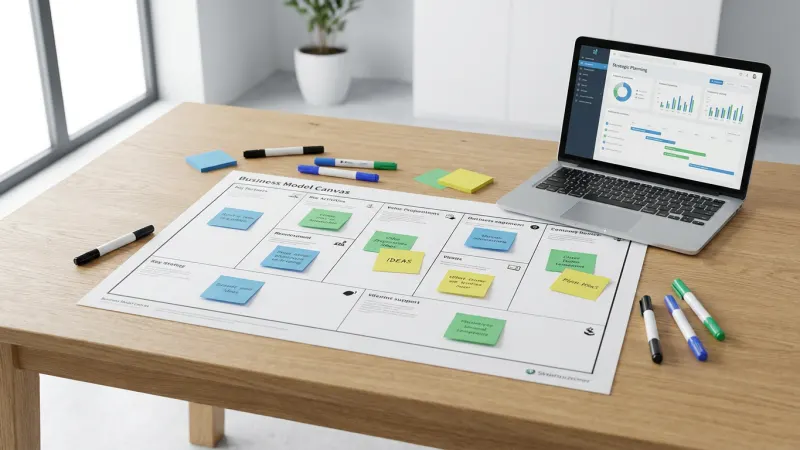
While 90% of entrepreneurs can sketch a Business Model Canvas in 30 minutes, only 23% can systematically validate whether their model will actually generate sustainable revenue. Imagine your startup launches with a promising product, but you’re left wondering why growth is stagnant. The issue often lies beneath the surface in an improperly validated business model. This guide will walk you through a 5-step framework to not only fill out your Business Model Canvas but also ensure each section is backed by solid decision frameworks and validation methods. You’ll gain insights into how to map your B2B strategy on a single page and avoid common pitfalls that lead 73% of startups to fail due to poor business model validation, not just product-market fit.
What Is the Business Model Canvas (And Why Templates Aren’t Enough)
The Business Model Canvas (BMC), introduced by Alexander Osterwalder, changed strategic planning by providing a one-page framework for mapping out key business components. But here’s the catch: simply filling out a template isn’t enough. Many entrepreneurs fill these boxes without looking into the strategic depth needed for successful execution. A startling 73% of startups fail because their business models aren’t validated beyond the initial sketch. This section will highlight the difference between traditional business plans and the canvas approach, and why strategic depth is important.
|
Factor |
Business Model Canvas |
Traditional Business Plan |
|
Focus |
Strategic components |
Detailed documentation |
|
Time to Complete |
1-3 hours |
Weeks to months |
|
Flexibility |
High |
Low |
|
Validation Depth |
Requires additional methods |
Often superficial |
The Business Model Canvas provides a rapid overview but lacks the inherent validation checks embedded in a full business plan. This is why the canvas needs to be complemented with decision frameworks and tests to ensure each assumption can lead to sustainable revenue.
The 9 Building Blocks: Your Complete Decision Framework
The heart of the Business Model Canvas lies in its nine building blocks, each important to your business strategy. These blocks aren’t just boxes to fill; they’re decision points that require validation. Let’s break them down with specific questions and interdependencies you might miss if you’re only copying from templates.
Begin with the value proposition, the cornerstone of your canvas. Ask yourself, “What unique value do we offer?” From there, consider customer segments: not just demographics, but the buying committees and decision units within organizations. Each block affects the others, like revenue streams dictating your cost structure.
|
Building Block |
Key Validation Question |
|
Value Proposition |
Does this address a critical customer pain? |
|
Customer Segments |
Have we identified all key decision-makers? |
|
Channels |
Are our channels optimal for delivery? |
|
Revenue Streams |
Can this model sustain long-term profitability? |
|
Cost Structure |
Do costs align with value delivery? |
Common mistakes include neglecting the interdependencies between these blocks, which can invalidate your entire model. For instance, a flawed customer segment can disrupt your channels and revenue streams, leading to an unsustainable business.
Customer Segments: Beyond Demographics to Decision-Making Units
Stop thinking of your customer segments as broad demographics; instead, map out B2B buying committees and decision-making units. A strong understanding of this section is important for B2B success. Unlike consumer personas, your segments in the B2B space are multifaceted, involving different roles and influences within an organization.
Use the Jobs-to-be-Done framework to identify what each decision unit is trying to achieve. Validate these segments through metrics like purchase frequency and engagement rates. A well-defined segment can reshape your entire canvas.
Consider this template for segment mapping:
- Influencers: Those who sway the decision
- Gatekeepers: Those who control access to decision-makers
- Decision Makers: Those who make the final purchase decision
- Users: End-users within the organization
Testing methods include surveys and pilot programs that measure segment engagement and conversion rates to ensure your model is grounded in reality, not assumptions.
Value Proposition Canvas Integration: The Missing Link
Most guides mention the value proposition without showing how to systematically integrate it with the Business Model Canvas. This is an important missing link. Osterwalder’s Value Proposition Canvas allows you to map pains, gains, and jobs effectively.
Start by mapping pain points and gains alongside key jobs your customers need done. This helps refine your value proposition before completing the full canvas. Use this mapping to test your proposition through A/B testing or pilot offerings.
This approach ensures your value proposition isn’t just a theoretical exercise but a validated driver of customer engagement and revenue. The pain-gain-job template provides a clear pathway to design and test your proposition effectively.
Revenue Model Architecture: Beyond ‘How You Make Money’
When it comes to revenue models, many guides oversimplify with the notion of “how you make money.” But there’s much more to it. Consider the seven B2B revenue model patterns, from subscription models to transaction-based systems, each with specific selection criteria.
Analyze your cost structure to ensure alignment with your revenue strategy. For instance, will your pricing strategy sustain your delivery costs? Effective revenue architecture integrates pricing with value delivery, ensuring profitability.
Use this selection framework:
- Subscription: Predictable revenue, higher customer lifetime value
- Transactional: Flexibility, potentially higher margins
- Freemium: High user base growth, conversion challenges
- Licensing: Intellectual property monetization, upfront fees
Cost structure analysis ensures each revenue type supports long-term sustainability, avoiding the pitfalls of mismatched costs and revenues.
Channel and Partnership Strategy: Your Go-to-Market Blueprint
Channels and partnerships aren’t separate checkboxes in your canvas; they’re integral to your go-to-market strategy. Evaluate channel effectiveness through scoring matrices that assess each channel’s ability to deliver your value proposition.
Calculate partnership ROI with detailed metrics, weighing traditional versus digital channels for optimization. This strategic integration maximizes delivery efficiency and market penetration.
Here’s a channel scoring matrix:
- Reach: How effectively does the channel reach target segments?
- Cost: What are the costs associated with the channel?
- Engagement: How well does the channel engage prospects?
- Conversion: What’s the channel’s conversion rate?
Strategically aligning channels and partnerships accelerates growth and reduces friction in your market entry.
Business Model Validation: Test Before You Scale
Many entrepreneurs skip the important step of validating their business model before scaling. A systematic approach to testing your Business Model Canvas hypotheses can save you from costly mistakes. Define key metrics for each building block to measure their performance.
Set pivot triggers based on these metrics to iterate your model effectively. You should conduct specific experiments to test each aspect, from pricing to customer acquisition channels.
Adopt this validation testing framework:
- Hypothesis Definition: Clearly state assumptions for each block
- Experiment Design: Create controlled tests to measure outcomes
- Data Collection: Gather quantitative and qualitative data
- Pivot Triggers: Identify metrics that signal a need for change
This method ensures your canvas is not just well-designed, but thoroughly vetted for real-world application.
From Canvas to Execution: Your 90-Day Implementation Plan
You’ve mapped your business model; now it’s time to execute. Transitioning from planning to execution requires a strategic 90-day roadmap. Prioritize insights from your canvas and allocate resources effectively.
Define success metrics and monitoring systems to track progress against your business goals. This implementation blueprint bridges the gap between theory and practice, setting the stage for sustainable growth.
Here’s your 90-day roadmap:
- Phase 1: Establish priorities based on canvas insights
- Phase 2: Allocate resources aligned with strategic goals
- Phase 3: Monitor success metrics and adjust tactics
This plan aligns your team around execution, ensuring you don’t just plan well but act decisively.
Conclusion: Time to Transform Your Business Model
Today, take the first step by designing your Business Model Canvas using this guide as your foundation. Validate each section systematically to ensure your model leads to sustainable revenue. Ready to map your B2B strategy on a single page? Dive into our 9-Block Framework for Startups and Map Your B2B Strategy on 1 Page. In the next decade, I predict that systematic model validation will become the standard for successful business launches. Don’t wait, start integrating these methods today.
FAQs: Your Canvas Questions Answered
What is a business model canvas?
The Business Model Canvas is a strategic management tool that helps you visualize and describe your business model on a single page. It includes nine building blocks that cover customers, value propositions, channels, revenue streams, and more. This tool enables quick iteration and validation of business ideas, making it important for startups looking to simplify their strategic planning.
How to fill out a business model canvas?
Filling out a Business Model Canvas involves detailing each of the nine building blocks with strategic insights and validation methods. Start with your value proposition and customer segments, then map out channels, cost structure, and revenue streams. Ensure each section answers specific validation questions to create a complete and reliable business model.
What’s the difference between Business Model Canvas and Value Proposition Canvas?
The Business Model Canvas provides a one-page overview of your business model, while the Value Proposition Canvas delves deeper into customer pains, gains, and jobs. Integrating both canvases ensures that your value proposition is well-defined and aligns with your broader business strategy, improving its effectiveness.
How long does it take to complete a business model canvas?
Completing a Business Model Canvas can take between 1 to 3 hours, depending on the depth of information and validation required. Quick sketches can be done within an hour, but a thorough, validated canvas requires additional time for research and strategic analysis. This ensures your canvas isn’t just complete but effective in guiding your business decisions.