
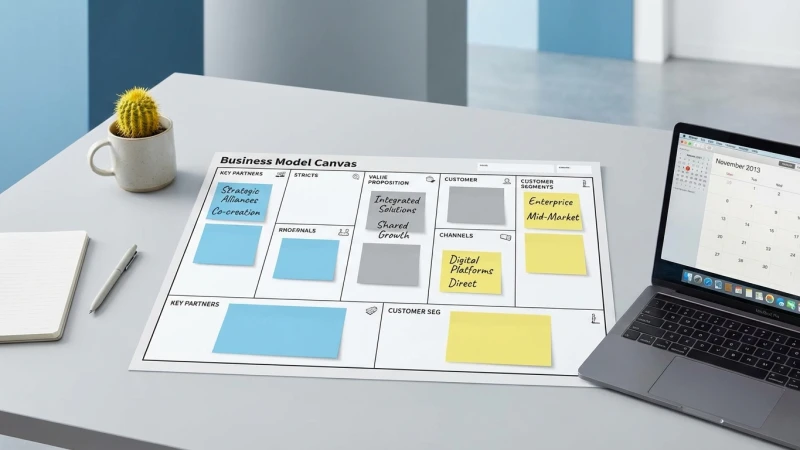
73% of startups fail because they build products nobody wants, but the companies that survive all have one thing in common: they mapped their business model before writing a single line of code. That’s where a business model canvas guide steps in as a lifeline. The cost of pivoting after launch can cripple startups, while early validation through a structured canvas can mean the difference between an abandoned concept and a market leader. In this article, you’ll get a 5-step framework to create and refine your B2B business model canvas, avoiding common pitfalls and evolving from startup to scale-up phases.
Why 73% of B2B Startups Fail at Business Model Design (And How Canvas Prevents It)
Why do so many brilliant ideas never see the light of day? The answer lies in business model clarity. According to CB Insights, a staggering 73% of startups fail due to premature scaling and lack of a solid business model. Imagine spending months on development only to realize your assumptions were wrong. This problem is not just about lost revenue, it’s about burning through your funding with nothing to show.
Here’s a breakdown of why clarity is critical:
|
Reason |
Impact |
Cost |
|
Unclear Business Model |
Poor product-market fit |
$50K+ in wasted development |
|
Late Pivoting |
Delayed traction |
Up to 6 months lost |
|
Failed Funding Rounds |
Lack of investor confidence |
Potential shutdown |
The business model canvas acts as your early warning system. Unlike a traditional business plan, it’s dynamic, allowing for rapid iteration. Your investors will appreciate your grounded approach, and you’ll appreciate the insights it provides.
The 9 Building Blocks: B2B Business Model Canvas Breakdown
Ready to dive into the business model canvas guide? The canvas comprises nine important building blocks that paint a complete picture of your business operation. Here’s how each block plays out in the B2B space:
- Customer Segments: In B2B, this means understanding your enterprise clients. Consider specific industries or company sizes that align with your solution.
- Value Propositions: What unique value do you offer that enterprise customers can’t refuse? It’s not just a feature set, but a compelling ROI story.
- Channels: How will you reach your clients? B2B often involves longer sales cycles through direct sales teams or channel partners.
- Customer Relationships: Think long-term engagements, account management, and strong CRM systems.
- Revenue Streams: Subscription models, usage fees, or licensing deals. B2B revenue can be complex but lucrative.
- Key Resources: Consider the technical infrastructure and talent needed to maintain your service quality at scale.
- Key Activities: These might include frequent product updates or dedicated customer support for B2B services.
- Key Partnerships: Integrations with other platforms can be critical, as can partnerships with industry influencers.
- Cost Structure: Focus on cost-efficient scaling, considering the high CAC (Customer Acquisition Cost) common in B2B.
Each block is interconnected. For instance, your key activities should support your value proposition, while your revenue streams need to justify your cost structure. The canvas template is your strategic dashboard, displaying how each element supports your overarching business goals.
Step-by-Step Canvas Mapping Process (With B2B Examples)
Now, let’s map out the process. I’ll guide you through a 9-step process that brings your business model canvas to life. Follow these steps to ensure nothing is left to assumption:
- Start with Customer Segments: Focus on identifying your primary segments. For a SaaS company, this could be mid-sized technology firms needing automation.
- Define Your Value Proposition: Articulate why your solution matters. Example: “We reduce administrative time by 30% for our clients.”
- Identify Channels: Decide how you’ll deliver value. Are you using direct sales, online channels, or partnerships?
- Establish Customer Relationships: Plan how to nurture relationships. SaaS companies might use dedicated account managers.
- Pin Down Revenue Streams: Define your pricing model. Is it subscription-based or a one-time licensing fee?
- List Key Resources: Identify the critical assets. This could be your technical team, proprietary technology, or even customer data.
- Outline Key Activities: Enumerate necessary actions, like continuous software updates and customer service operations.
- Build Key Partnerships: Identify potential partners. Consider technology alliances or strategic resellers.
- Summarize Cost Structure: Be realistic about operational costs. Factor in everything from salaries to server costs.
To validate these steps, ask probing questions. For example, “What alternative solutions do our customer segments currently use?” This will help uncover hidden assumptions. Review an example of a B2B SaaS company that successfully applied this process:
5 Critical B2B Canvas Mistakes (That Kill Scalability)
Creating a business model canvas isn’t just about filling in blanks. Here are five common mistakes that can sabotage your scalability:
|
Mistake |
Impact |
Solution |
|
Ignoring Customer Feedback |
Missed market needs |
Implement regular feedback loops |
|
Overlooking Competitors |
Surprise competition |
Conduct competitive analysis frequently |
|
Complex Revenue Streams |
Confusing value proposition |
Simplify pricing models |
|
Vague Value Proposition |
Poor customer understanding |
Focus on specific outcomes |
|
Underestimating Cost Structure |
Budget overages |
Regular financial reviews |
Addressing these mistakes early can save significant resources. For instance, by simplifying revenue streams, you can improve clarity and improve client acquisition.
Canvas Evolution Framework: Startup to Scale-Up Phases
Your business model canvas isn’t static. It should evolve alongside your company. Here’s how to adapt it through various growth phases:
- MVP Phase: Focus on validating customer segments and value propositions.
- Product-Market Fit: Start refining revenue streams and cost structures as you gain traction.
- Scaling Phase: simplify operations by improve key activities and partnerships.
Track key metrics like customer acquisition cost and lifetime value to guide these evolutions. If certain elements underperform, consider a strategic pivot. The evolution timeline provides a clear path for growth.
Validation Methods: Testing Your Canvas Assumptions
Turning your business model canvas into a validated strategy requires testing. Here’s a checklist to guide you:
- Customer Interviews: Use structured questions to verify assumptions about customer needs.
- Prototype Testing: Develop simple prototypes to test the feasibility of your value propositions.
- A/B Testing: Implement this for pricing models and marketing channels to measure effectiveness.
Metrics like conversion rates and customer feedback are important. They inform whether your assumptions hold true. Regular reviews and adjustments help maintain alignment with market demands.
Free Business Model Canvas Templates + Tools
Ready to get started? Here are some resources to help you design your canvas:
- Downloadable Canvas Templates: Tailored for SaaS, enterprise, and startup models.
- Digital Tools Comparison: Tools like Canva and Miro allow for collaborative canvas creation.
|
Tool Name |
Key Feature |
Best For |
|
Canva |
Customizable templates |
Visual learners |
|
Miro |
Real-time collaboration |
Remote teams |
These tools help smooth integration with your planning processes, making it easy to update and share your business model canvas as needed.
FAQ Section
What is business model canvas?
A business model canvas is a strategic tool that outlines key components of a business model on a single page. It helps in visualizing, assessing, and iterating the business concept.
How to fill out a business model canvas?
Begin with customer segments, then articulate the value proposition, and continue filling out the remaining blocks one by one. Ensure each block reflects direct insights or validated assumptions.
What’s the difference between business model canvas and value proposition canvas?
The business model canvas provides a complete view of the business, while the value proposition canvas focuses specifically on the value exchange between a company and its customers.
How often should you update your business model canvas?
Update your business model canvas whenever there is a significant change in your business environment or strategy. Regular reviews, ideally quarterly, ensure ongoing relevance and alignment.
Conclusion
change your ideas into a thriving business requires more than just creativity, it requires a strategy. Today, I urge you to start mapping your business model canvas. It’s your blueprint for success, offering clarity and direction. For more insights on strategic planning, explore our homepage at Valasys Business. As your business grows, so too will your canvas, evolving from a startup tool to a cornerstone of your scale-up strategy.