
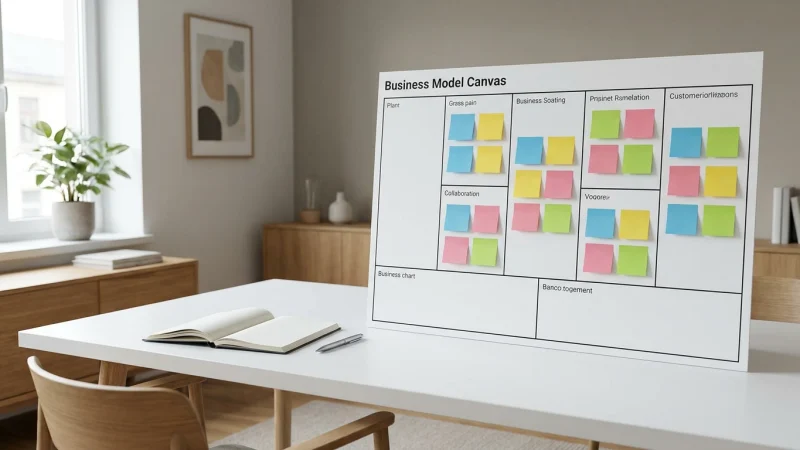
While 90% of startups fail within their first year, the successful 10% have one thing in common: they mapped their business model before building their product. The truth is, understanding and implementing a business model canvas (BMC) can be the difference between launching a thriving company and watching your startup dream crumble. In this article, you’ll uncover a complete BMC guide that not only elucidates the strategic framework but also provides a practical playbook featuring real validation methods, industry-specific templates, and pitfalls to avoid. By the end, you’ll be equipped to plot your business on a single page, ready to conquer the market.
What is the Business Model Canvas (And Why 73% of Startups Get It Wrong)
The business model canvas is a strategic framework developed by Alexander Osterwalder. It allows you to describe, design, challenge, and pivot your business model. Despite its simplicity, 73% of startups fail to implement it effectively, often misunderstanding its purpose. The BMC consists of nine interconnected building blocks: Customer Segments, Value Propositions, Channels, Customer Relationships, Revenue Streams, Key Resources, Key Activities, Key Partnerships, and Cost Structure. Each element plays a critical role in capturing the core aspects of your business model on a single page, which helps in making strategic decisions quickly.
| Aspect | Business Model Canvas | Traditional Business Plan |
| Length | 1 Page | 20-50 Pages |
| Focus | Visual Representation | Detailed Documentation |
| Flexibility | High | Low |
| Time to Create | Days | Weeks or Months |
Unlike the exhaustive nature of a traditional business plan, a BMC provides a concise and flexible approach. By visualizing connections between key components, it enables rapid adjustments in strategy. For instance, a SaaS company might use it to realign customer segments with new market trends identified through resources. The key is treating the BMC as a dynamic tool, adaptable and evolving, not a static document.
The 9 Building Blocks: Your Complete Implementation Framework
Ready to dive into the heart of the business model canvas? Each block serves a specific purpose, and understanding them thoroughly is important.
1. Customer Segments
Companies often falter by generalizing their target audience. Instead, identify specific customer segments that bring value. For example, a company focusing on tech-savvy millennials would differ from one targeting retirees. Ask yourself: Who are our most profitable customers? How do their needs differ? Tailor your offerings accordingly.
2. Value Propositions
What makes your product or service unique? Articulate your value proposition clearly. If you’re offering a cloud-based solution, specify the exact benefits like “cut IT costs by 30% for SMEs.” The best value propositions address customer pain points directly.
3. Channels
How will you deliver your value proposition? Identify the most effective channels to reach your customers. For B2B companies, this might include webinars, influencer partnerships as outlined in The Power of B2B Influencer Marketing, or targeted email campaigns.
4. Customer Relationships
Establish how you’ll interact with your customers. Will it be personal support, automated services, or community engagement? A subscription-based model might require sustained interaction, whereas a transactional model may not.
5. Revenue Streams
Define how money flows into your business. Is it through direct sales, subscription models, or licensing? Imagine a SaaS platform with tiered pricing, each tier could target a different segment, maximizing revenue potential.
6. Key Resources
Pinpoint the important resources needed to deliver your value proposition. This could include skilled personnel, intellectual property, or a strong IT infrastructure. Consider partnerships that might supplement these resources.
7. Key Activities
What critical actions must your team perform to achieve business success? For a consultancy, this might involve research and developing proprietary frameworks. For an e-commerce business, it may include inventory management and customer service.
8. Key Partnerships
Identify relationships that can support your business model. Strategic alliances or supplier agreements can reduce risks and costs. For instance, partnering with a manufacturing firm could lower production costs by 20%.
9. Cost Structure
Understand your cost drivers. Are they fixed, variable, or both? Analyze where you can cut costs without sacrificing quality. A company focusing on digital products will have different cost considerations than one reliant on physical goods.
| Industry | Example |
| SaaS | Subscription Model with tiered pricing |
| Consulting | Project-based Revenue with retainer clients |
| E-commerce | Direct sales with a diversified product line |
| Marketplace | Commission-based Revenue on each transaction |
Validating these blocks with real-world data and feedback is important. Use a checklist to ensure every assumption is based on evidence, not wishful thinking. Without this, your business runs the risk of building on unstable ground.
BMC Template Library: Industry-Specific Canvases That Actually Work
Templates make life easier. By providing a structured layout, they simplify the process of filling out your business model canvas. Let’s explore industry-specific templates that can serve as your roadmap.
SaaS Business Model Template
This template addresses subscription revenue streams, customer retention strategies, and innovation cycles. It’s designed to accommodate the fast pace of software evolution.
Consulting/Services Template
Focuses on client management, project deliverables, and repeat business. It’s important for managing complex service negotiations.
E-commerce Template
Details supply chain management, digital marketing channels, and user experience enhancements. This template is especially useful for those exploring home-based e-commerce ventures.
Marketplace Template
Focuses on network effects, buyer-seller dynamics, and commission strategies. Important for platforms attempting to balance two-sided market growth.
Each template in our downloadable collection is filled with example data to guide you through the process. These pre-filled templates show real scenarios, providing a tangible way to adapt the canvas to your unique business needs.
Value Proposition Canvas Integration: Connect Customer Needs to Solutions
Integrating the Value Proposition Canvas (VPC) with the BMC creates a powerful duo. The VPC zeroes in on your value proposition and customer segments, making them more effective.
The Customer Jobs-to-be-Done framework helps identify what your customers are trying to achieve. Are they seeking efficiency, comfort, or growth? Knowing this drives your product development process.
Map out specific pain points and gain creators. For instance, if your customers frequently mention issues with delivery speed, that’s a pain point to address. Solutions could involve partnerships with faster logistics providers.
Validating the fit between the VPC and BMC is important. Use our integration workflow to map how each element complements the other, ensuring they work in concert towards your business goals.
Validation Playbook: Test Your Canvas Before You Build
Before you build, you must validate. This step change assumptions into facts and prevents costly missteps.
Assumption Mapping Technique
List all assumptions within your BMC. Rank them by importance and uncertainty. Validate the most critical assumptions first with targeted experiments.
Interview Scripts for Each Building Block
Have tailored scripts ready to extract valuable insights. When testing revenue streams, questions might revolve around willingness to pay or ideal pricing structures.
Metrics to Track for Validation
Identify key performance indicators (KPIs) for each block. For customer segments, track metrics like acquisition cost and lifetime value. Use data to refine your canvas iteratively.
Pivot Indicators and Decision Framework
Sometimes validation will reveal the need to pivot. Establish thresholds for when a pivot is necessary and use a decision framework to guide these critical changes.
Our validation checklist and interview question bank provide you with the resources needed to gather practical insights and ensure your canvas reflects reality, not aspirations.
Common BMC Mistakes (And How to Avoid Them)
The simplicity of the BMC can be deceptive, leading to common mistakes.
Over-complicating customer segments can dilute focus. Stick to primary segments that directly impact your business. Similarly, vague value propositions fail to resonate. Be specific, like offering a “24/7 customer support hotline” instead of just “great customer service.”
Unrealistic revenue assumptions can sink a business. Base forecasts on data, not hope. Ignoring key partnerships is another pitfall. These alliances can scale operations and reduce costs dramatically.
Use our red flags checklist to audit your canvas and avoid these traps. Before/after examples show the impact of refining these areas.
From Canvas to Execution: Your 30-Day Implementation Plan
The journey from canvas to execution is where many falter. Our 30-day plan provides a structured approach.
Week 1-2: Research and Assumptions
Gather data, conduct market analysis, and map out assumptions. This groundwork is important for an informed canvas.
Week 3: Initial Canvas Creation
With well-researched insights, create your initial BMC. Be specific and data-driven.
Week 4: Validation and Iteration
Begin testing your assumptions. Use tools like surveys and customer interviews to gather feedback. Iterate based on findings.
Our 30-day action plan template and tool recommendations help maintain momentum and keep your strategy aligned with market needs.
Conclusion
The best action you can take today is to map out your business model on a canvas. Begin with the nine building blocks, validate each assumption, and adapt your strategy as necessary. For more insights, dive into our blogs and whitepapers. With a clear BMC, you’re not just planning, you’re equipping your business for resilience and growth in a competitive market.
What is a business model canvas?
A business model canvas is a strategic tool for visualizing a company’s key operational elements on a single page. Developed by Alexander Osterwalder, it helps entrepreneurs quickly sketch out business concepts, making it easier to identify strengths and weaknesses.
How to fill out a business model canvas?
To fill out a business model canvas, start with customer segments and value propositions. Gradually move to channels, customer relationships, and revenue streams. Lastly, define key resources, activities, partnerships, and costs. Each section should be concise and based on verified data.
What’s the difference between business model canvas and value proposition canvas?
The business model canvas covers your entire business model, including how you create, deliver, and capture value. The value proposition canvas focuses specifically on the alignment between your product’s value and customer needs. They complement each other in business strategy.
How long does it take to complete a business model canvas?
Creating a well-researched business model canvas typically takes several days to weeks. Initial drafts can be sketched in a day, but thorough validation and iteration require more time to ensure accuracy and strategic alignment.