
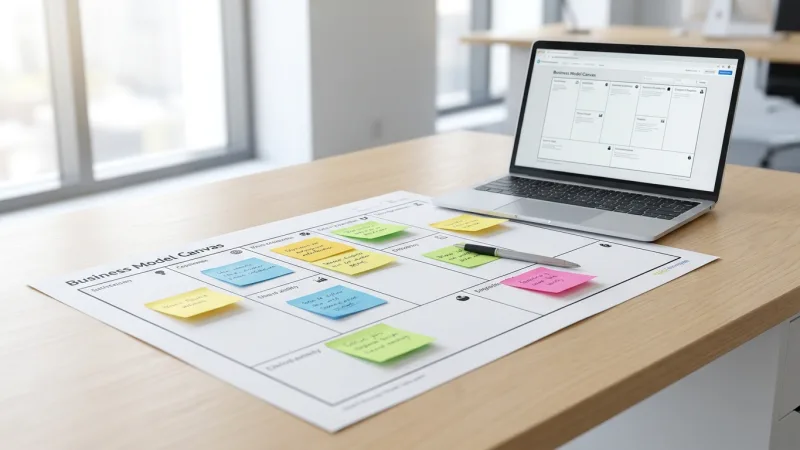
73% of startups fail not because they build the wrong product, but because they never validate their business model. The Business Model Canvas (BMC) is your ticket to avoiding this costly pitfall. In this guide, you’ll not only learn how to fill out your canvas but also how to iterate it through real customer feedback loops. Expect practical steps, including a 5-step framework, to ensure your BMC is always aligned with market demands. This isn’t just advice, it’s your roadmap to success.
The Business Model Canvas: Your Strategic North Star
There’s a reason the Business Model Canvas has become the strategic tool of choice for 70% of B2B founders. Unlike bulky business plans, the BMC offers a clear, concise way to visualize your entire business on a single page. Created by Alexander Osterwalder, the BMC distills the complexities of business planning into nine important blocks. This approach not only saves time but also dramatically improves strategic clarity.
Traditional business plans often fail because they are static and cumbersome. They lack the adaptability needed in today’s fast-paced environment. In contrast, the BMC is dynamic and flexible, allowing founders to pivot quickly based on feedback. This agility is critical, especially when 70% of startups admit to having made a significant pivot in their lifecycle.
| Aspect | Business Model Canvas | Traditional Business Plan |
| Length | 1 page | 30+ pages |
| Flexibility | Highly adaptable | Rigid and static |
| Time to Create | 1-2 hours | Weeks to months |
For founders aiming to stay competitive, embracing the BMC isn’t just smart, it’s important. By focusing on adaptability and continuous validation, you ensure your business doesn’t just survive but thrives in any market condition. Read more on Why Every Business Must Embrace Business Model Innovation?
The 9 Building Blocks: Your Complete BMC Framework
The Business Model Canvas breaks down business planning into nine intuitive blocks. Each represents a critical component of your business strategy, from defining key partners to outlining cost structures. Let’s dissect these elements with a focus on B2B applications.
- Customer Segments: Define who you are creating value for. In B2B, this means understanding the decision-making unit, often a complex web involving procurement, IT, and finance.
- Value Propositions: What problem are you solving? A strong value proposition turns leads into customers.
- Channels: How do you deliver value? B2B channels often involve direct sales, online platforms, or partnerships.
- Customer Relationships: How do you engage customers? Automated services, personal assistance, or communities?
- Revenue Streams: Identify how your business earns money. Recurring subscriptions or one-time sales?
- Key Resources: What assets are important to deliver your value proposition? People, technology, or intellectual property?
- Key Activities: What actions do you need to take? This could be production, problem-solving, or networking.
- Key Partnerships: Identify which external parties can boost your business. Align with suppliers or allies?
- Cost Structure: Understand your primary costs. Are they fixed, variable, or sunk?
Founders often make the mistake of overly focusing on their product without adequately defining their customer segments or value propositions. Avoid these pitfalls by using our detailed B2B Strategic Planning: 7-Step Framework for 12% Revenue Growth.
| Block | Common B2B Mistake |
| Customer Segments | Underestimating the DMU complexity |
| Value Propositions | Focusing on features, not solutions |
| Revenue Streams | Ignoring recurring revenue opportunities |
Customer Segments: Finding Your Ideal B2B Buyers
Identifying the right B2B customer segments is important. Unlike B2C where customers act individually, B2B buyers are often a committee. This means mapping out the decision-making unit (DMU) is important. Your DMU might include the CEO, CFO, and the end-users within a company.
To effectively segment your B2B market, consider factors like industry, company size, and decision-maker roles. Use this B2B customer segmentation template to pinpoint your audience. It’s a systematic approach that clarifies who benefits the most from your solutions.
For example, a SaaS company specializing in HR software might initially target mid-sized tech companies with 50-200 employees. However, real validation comes from customer interviews and data analysis, revealing the most receptive segments.
Value Propositions That Convert: The Canvas Core
Your value proposition sits at the heart of your Business Model Canvas. It’s not just what you do, but how you change your customers’ businesses. For B2B, this often means increased efficiency, cost savings, or improve security.
The formula is simple: [What your product does] + [Key benefit] + [Emotional tie]. For example, “Our CRM software automates 90% of your manual entry, saving your team 20 hours weekly and allowing them to focus on strategic growth.”
Integrating the Jobs-to-be-done framework can improve your propositions. This approach ensures your offering aligns with what jobs your customers are hiring your product to do.
Measure the effectiveness of your propositions using a simple ROI calculation framework. If your software saves a company $100,000 annually and costs $10,000, your value is indisputable.
Revenue Streams and Pricing Models for B2B Success
How you earn is just as critical as what you earn. B2B businesses often grapple with choosing between recurring revenue models like subscriptions and one-time sales. The choice depends on your product’s nature and customer expectations.
Recurring models offer predictability, while one-time sales provide immediate capital influx. Compare these options using our revenue model comparison table.
| Model | Pros | Cons |
| Subscription | Predictable revenue, customer retention | Requires ongoing service delivery |
| One-time Sale | Immediate cash flow, no future obligations | Lacks steady income |
Pricing psychology also plays a significant role, especially in enterprise sales. Understanding how discounts, free trials, and value-based pricing affect decision-making can improve your strategy. For instance, a case study from a cybersecurity firm shows a 30% increase in conversions after adopting value-based pricing.
The Validation Loop: Testing Your Business Model Canvas
Completing your Business Model Canvas is just the beginning. The real magic happens when you start testing and iterating your assumptions through a validation loop. This involves cycles of customer interviews, hypothesis testing, and making informed pivots.
Our validation roadmap process outlines how to gather practical feedback. Start by formulating hypotheses about your value proposition and customer segments. Then, engage your target audience through interviews and surveys.
The key is in asking the right questions. Use our interview question templates to uncover insights that guide your pivots. Common pivot indicators include consistent feedback on pricing, features, or market fit.
| Pivot Decision Criteria | Action |
| Pricing feedback | Reevaluate pricing strategy |
| Feature requests | Adjust product development roadmap |
| Market fit discrepancies | Explore new customer segments |
By continuously validating your Business Model Canvas, you ensure that your business remains aligned with real market needs, minimizing the risk of unforeseen failures.
From Canvas to Action: Implementation Roadmap
Your Business Model Canvas is a blueprint, but execution makes the blueprint a reality. Bridge the gap between planning and doing with a 30-60-90 day implementation plan. This structured approach allows you to prioritize tasks, allocate resources, and measure progress effectively.
Track key performance indicators (KPIs) for each BMC block using our KPI dashboard framework. This helps you measure success and identify areas needing adjustment.
| Timeline | Action Items | KPIs |
| 30 Days | Complete market research, finalize canvas | Customer interviews, hypothesis validation |
| 60 Days | Launch pilot project, start sales outreach | Number of leads, conversion rates |
| 90 Days | Review outcomes, make adjustments | Customer retention, revenue growth |
Beware of common pitfalls such as losing focus on core activities or misallocating resources. Maintain clear priorities and accountability. For more insights, explore our guide on 5 AI Technology Trends change Every Industry in 2024.
FAQ
What is a business model canvas?
The Business Model Canvas is a strategic tool that outlines the important elements of a successful business model on a single page. It includes nine blocks: Customer Segments, Value Propositions, Channels, Customer Relationships, Revenue Streams, Key Resources, Key Activities, Key Partnerships, and Cost Structure. Each block prompts you to think critically about your business strategy.
How to fill out a business model canvas?
Start by clearly defining your customer segments and value propositions. Move on to channels and customer relationships, ensuring alignment with the target audience. Identify your revenue streams, important resources, and key partners. Finally, outline your key activities and cost structure. Use real-world data and customer insights to guide your decisions.
How long does it take to complete a business model canvas?
Typically, completing a Business Model Canvas takes 1-2 hours. This timeframe allows for concise, focused thinking about each business aspect. However, initial completion is just the start; frequent updates based on market feedback are important for staying relevant and competitive.
What’s the difference between Business Model Canvas and Lean Canvas?
The Lean Canvas is a variation of the Business Model Canvas, tailored for startups. It shifts focus to problems, solutions, key metrics, and unfair advantage. While the BMC is broader, suitable for established businesses, the Lean Canvas prioritizes rapid iteration and market validation, ideal for early-stage startups.
Today’s action? Start drafting your Business Model Canvas. Use this template to sketch your ideas. Then, cycle through validation and iteration using real customer feedback. Learn more strategies in our 10 PR Strategies for 2026: Drive Trust, Influence, & Results. If you can change your canvas into tangible action, your business will undoubtedly thrive in the years to come.