
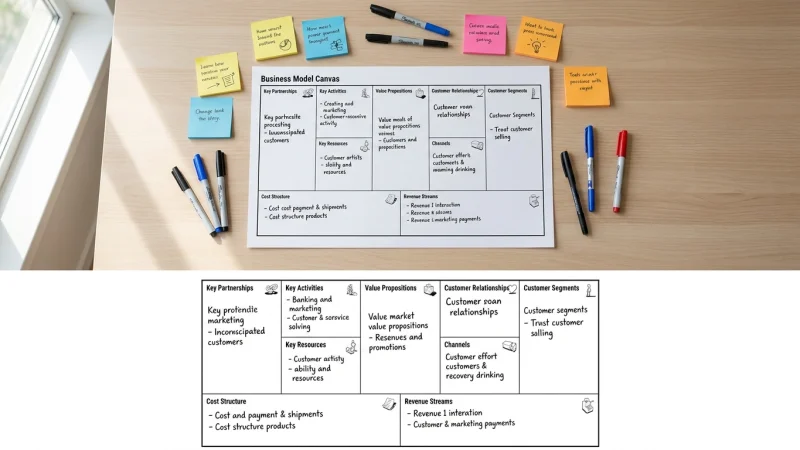
73% of businesses fail because they never validate their business model assumptions. But what if you could map, test, and validate your entire business strategy in just 20 minutes? The business model canvas offers a visual framework to align your team, identify gaps, and in the end, prevent costly missteps. Today, you’ll gain a complete understanding of each canvas block, common pitfalls to avoid, and fill-in-the-blank frameworks to guide your strategic planning. Plus, we’ll share validation techniques from over 100 B2B case studies to ensure your model is rock-solid.
Why 73% of Business Models Fail (And How the Canvas Prevents This)
Most businesses crumble due to a lack of strategic clarity and alignment. Harvard Business Review reports that 73% of companies fail because they don’t validate critical business assumptions. The top-three reasons? Misaligned customer needs, ineffective revenue models, and overlooked key partnerships. But there’s hope.
The business model canvas, a tool praised in our guide on business model innovation, visually maps your business strategy, uncovering strategic blind spots before they become fatal. It ensures clarity by forcing teams to articulate their assumptions and visualize interdependencies.
|
Failure Cause |
Impact |
Canvas Solution |
|
Misaligned Customer Needs |
67% drop in customer retention |
Customer Segments & Value Propositions blocks |
|
Ineffective Revenue Models |
Revenue targets missed by 30% |
Revenue Streams & Cost Structure blocks |
|
Overlooked Partnerships |
Lost competitive advantage |
Key Partners block |
The 9 Building Blocks: Your Complete Business Model Canvas Framework
The business model canvas comprises nine important components, each pivotal yet often misunderstood. Let’s break them down with a B2B lens, highlighting interdependencies and optimal order of completion for insightful strategy development.
- Customer Segments: Define your target audiences. For example, a SaaS company might target small businesses and large enterprises differently.
- Value Propositions: Clearly articulate the unique value your product provides. A managed service could offer 24/7 support and 99% uptime as key benefits.
- Channels: Determine how you reach customers. Will you rely on digital marketing channels or strategic partnerships?
- Customer Relationships: Decide how you’ll build and maintain relationships. For B2B, this might mean dedicated account managers.
- Revenue Streams: Identify how you’ll earn money. Options include subscription models or one-time sales, as highlighted in our whitepapers.
- Key Resources: List important assets like patents, technology, or your skilled team.
- Key Activities: What actions are required to deliver your value proposition? Think development cycles or customer service processes.
- Key Partnerships: Identify external companies that amplify your business. This could include suppliers or distribution partners.
- Cost Structure: Detail costs, from fixed to variable, ensuring financial alignment with your strategy.
Each block must be completed with precision. Imagine starting with customer segments to align your value propositions effectively, a principle advocated in our B2B strategic planning framework.
Step-by-Step: How to Fill Out Your Business Model Canvas in 20 Minutes
Ready to execute? This section is your playbook for filling out the business model canvas efficiently. Set a 20-minute timer and use the framework below to guide you.
- Customer Segments: Ask, “Who are our most important customers?” and “What problems are we solving for them?”
- Value Propositions: Use the question, “What value do we deliver to the customer?”
- Channels: Determine how you’re going to deliver your value. “Through which channels do our customers want to be reached?”
- Customer Relationships: Establish how you’ll interact. “What type of relationship does each customer segment expect us to establish?”
- Revenue Streams: Consider, “How do our customers prefer to pay?”
- Key Resources: List resources needed. “What key resources do our value propositions require?”
- Key Activities: Define critical actions. “What key activities do our value propositions require?”
- Key Partnerships: Identify important allies. “Who are our key partners and suppliers?”
- Cost Structure: Analyze costs. “What are the most important costs inherent in our business model?”
Validation checkpoints are important. For each block, verify assumptions through customer interviews, A/B tests, or market data analysis. In our guide on implementing RPA, we emphasize the importance of iterative testing for strong strategies.
Customer Segments and Value Propositions: The Make-or-Break Foundation
These are the heart of your business model canvas. Get them right, and the rest falls into place. In B2B, segments can be nuanced. Consider verticals like healthcare versus manufacturing, each with distinct needs.
Employ techniques like market segmentation to better understand your audiences. We discuss relevant methods in our e-commerce business ideas article for entrepreneurs.
|
Segment |
Value Proposition |
Testing Method |
|
Small Business IT |
Affordable IT solutions with rapid deployment |
Customer interviews and pilot programs |
|
Enterprise Healthcare |
High-compliance data management tools |
A/B testing and compliance audits |
Alignment is critical. Use a value proposition testing framework to ensure your offerings meet segment expectations. Misalignment leads to product-market fit issues, often discussed in our competitive analysis frameworks.
Revenue Streams and Cost Structure: Building Your Financial Engine
Revenue and costs drive your business’s sustainability. Neglecting these could lead to insolvency. Explore seven B2B revenue models, each with distinct benefits:
- Subscription
- Licensing
- Freemium
- Brokerage
- Advertising
- Usage Fee
- Sponsorship
Our article on e-commerce strategies emphasizes the importance of choosing the right model for predictable revenue.
Cost structure improve uses templates and tools to examine fixed vs. variable costs. These align with your strategy, ensuring efficient operations. Analyze unit economics like customer acquisition cost (CAC) and lifetime value (LTV) for financial health, similar to the insights found in our funding decision guide.
Key Partners and Resources: Building Your Competitive Moat
Partners and resources are your strategic advantage. They’re often overlooked, yet they’re important to creating a sustainable competitive moat.
Start with a partnership strategy framework. Evaluate potential partners not just for their offerings, but how they improve your value proposition. Tools for this are found in our B2B influencer marketing guide.
Resource audits reveal critical gaps and redundancies. By aligning resources with strategic goals, you create efficiencies that ensure you’re not just surviving, but thriving. This step complements strategies we discuss in our AI trends article.
Canvas Validation: Testing Your Model Before You Build
Before you hit the ground running, validate. Hypothesis-driven testing prevents costly missteps, ensuring you’re building on a solid foundation. Create experiments to test assumptions, using validation metrics like net promoter score (NPS) and customer lifetime value (CLV).
- Define Hypotheses: What assumptions are critical to your model?
- Test and Measure: Use tools like surveys or analytics to gather data.
- Analyze Results: How do results align with expectations?
- Pivot or Persevere: Decide based on data. Use a pivot decision matrix for structured adjustments.
Our article on AI and automation illustrates the importance of timely pivots in evolving markets.
Real B2B Canvas Examples: SaaS, Services, and Manufacturing Models
Ready for inspiration? Let’s explore three complete canvas examples across different B2B sectors. These real-world applications provide insights into practical adaptations and success factors.
SaaS Example
A cloud-based software solution offering integrated project management tools. Success was achieved by aligning value propositions with SMB needs, delivering efficiency through minimal onboarding time.
Service Example
A consulting firm specializing in digital change. Key success factors included strategic partnerships with tech providers, enabling rapid deployment of services across industries.
Manufacturing Example
A manufacturer of eco-friendly packaging. By differentiating through sustainable practices and strategic supplier partnerships, they secured a strong market position.
Adapting strategies to suit different industries is important. Explore our insights in Blue Ocean Strategy examples to carve untapped niches.
Conclusion: Take Action Today
Today, commit to mapping your business on the business model canvas. Download an interactive template, gather your team, and start identifying assumptions. Check out our business blogs for additional insights as you refine your model. In a rapidly evolving market, those who continuously test and adapt will lead the way.
FAQs
What is a business model canvas?
The business model canvas is a strategic management tool that provides a visual chart describing a company’s value propositions, infrastructure, customers, and finances. It helps firms align their activities by illustrating potential trade-offs.
How to fill out a business model canvas?
Start by identifying customer segments and value propositions. Then, fill out channels, customer relationships, revenue streams, key resources, key activities, key partners, and cost structures. Use validation techniques to test assumptions.
What’s the difference between Business Model Canvas and Value Proposition Canvas?
The Business Model Canvas offers a macro view of how a company creates, delivers, and captures value. The Value Proposition Canvas zooms in on the value proposition, focusing on customers’ needs and aligning solutions with them.
How often should I update my business model canvas?
Update your business model canvas regularly, at least quarterly, or whenever significant market changes occur. This ensures your strategy aligns with current market needs and opportunities.