
While 90% of startups fail due to poor business model design, companies using the Business Model Canvas (BMC) have a 73% higher success rate. They also reach profitability 40% faster than those relying on traditional business plans. Imagine change your business clarity in just an hour instead of spending weeks. This guide will arm you with a step-by-step framework and industry-specific templates, making the Business Model Canvas Guide your new strategic weapon.
What Is a Business Model Canvas (And Why 73% of Successful Startups Use It)
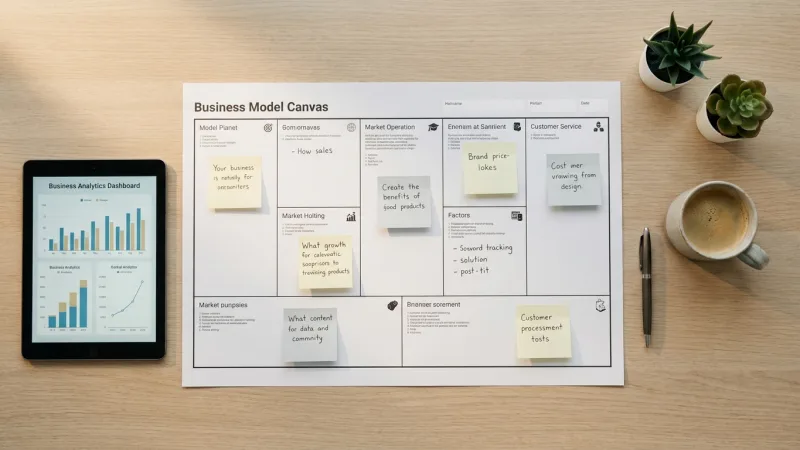
The Business Model Canvas is a strategic management tool originated by Alexander Osterwalder. Unlike the traditional and often cumbersome business plans, it offers a visual chart with nine important elements, allowing you to sketch out the building blocks of your business on a single page. The key benefit? Time. You can draft a complete model in just one hour, compared to the 40+ hours a traditional business plan requires.
|
Aspect |
Business Model Canvas |
Traditional Business Plan |
|
Time to Create |
1 hour |
40+ hours |
|
Visual Ease |
High |
Low |
|
Flexibility |
High |
Low |
|
Success Rate Impact |
73% higher |
N/A |
In the competitive B2B space, a quick and efficient business model canvas can be the difference between scaling fast or languishing. The BMC is not only about speed; it’s about proven results, driving a higher success rate among startups.
The 9 Building Blocks: Your Complete BMC Framework Breakdown
Think of the Business Model Canvas as your business on a single page, divided into nine interconnected blocks. Understanding each one is important for B2B success.
- Customer Segments: Who are you serving? Define your target audience with precision.
- Value Propositions: What makes you stand out? Offer clear reasons for customers to choose you.
- Channels: How do you deliver your value? Select the most effective mediums.
- Customer Relationships: How will you maintain them? Choose strategies for engagement and retention.
- Revenue Streams: Where will you earn money? List all possible income sources.
- Key Resources: What assets do you require? Include both tangible and intangible resources.
- Key Activities: What must you do to deliver your value? Identify core actions necessary for success.
- Key Partnerships: Who will help you? Consider alliances that will propel your business forward.
- Cost Structure: What are your expenses? Outline all costs related to operation and growth.
A common mistake? Neglecting the interdependencies between blocks. For instance, your value proposition directly influences customer relationships and channels. Industry-specific variations matter too. In SaaS, for example, recurring revenue streams are pivotal, whereas e-commerce focuses heavily on channels and customer relationships.
Step-by-Step: How to Fill Out Your Business Model Canvas (With Validation)
Here’s your guide to change ideas into practical plans. Start from customer segments and work your way to cost structures, validating each step.
- Identify Customer Segments: Use customer interviews to validate your assumptions. Ensure you know exactly who will buy and why.
- Clarify Value Propositions: Test your offerings in small markets first.
- Select Channels: Experiment with different channels for the most reach and feedback.
- Define Customer Relationships: Ensure methods are sustainable and flexible.
- Determine Revenue Streams: Run financial models on various scenarios.
- Identify Key Resources: Validate the necessity of each resource to avoid unnecessary costs.
- Outline Key Activities: Focus on activities contributing directly to your value proposition.
- Secure Key Partnerships: Seek partnerships that align strategically with your goals.
- Assess Cost Structure: Review expenses regularly to keep them aligned with your strategy.
Red flags? If your customer segment doesn’t match revenue streams, you’re heading for trouble. Iterate continuously, using feedback to refine and perfect. Refer to this mapping guide for deeper insights on iteration.
Industry-Specific BMC Templates: SaaS, E-commerce, and Consulting
Using industry-specific templates, you’ll see a significant uplift in performance metrics.
SaaS Example:
- Customer Segments: Mid-sized corporations
- Value Propositions: Automated workflow solutions
- Revenue Streams: Subscription-based
E-commerce Example:
- Customer Segments: Online shoppers
- Value Propositions: Unique product offerings
- Revenue Streams: Sales and affiliate marketing
Consulting Example:
- Customer Segments: Large enterprises
- Value Propositions: Strategic planning
- Revenue Streams: Project-based fees
Pre-filled templates allow for quick adjustments and strategy testing. Common patterns show that SaaS companies benefit most from consistent revenue streams, whereas e-commerce thrives on diverse channels.
BMC Success Stories: 3 Companies That Generated $10M+ Using This Framework
Airbnb’s use of the Business Model Canvas was pivotal during its pivot from renting airbeds to becoming a marketplace for travel accommodation. By focusing on their value proposition and customer segments, they exploded their revenue figures.
Slack leaned on the BMC to transition from a failed game company to a B2B communication powerhouse. Their focus on customer relationships and key partnerships drove this change.
During the pandemic, Zoom use the BMC to scale rapidly, focusing on channels and customer relationships to meet soaring demand. They adapted quickly, showing the BMC’s value in fast-changing markets.
The BMC help key decisions, driving revenue growth and market adaptability. Inspired by these stories, you can adapt strategies into your B2B strategy framework.
Advanced BMC Techniques: Value Proposition Canvas Integration
Ready to go deeper? The Value Proposition Canvas (VPC) complements the BMC by honing in on customer-centric strategies.
The VPC allows you to map customer jobs-to-be-done, aligning your offerings directly with customer pain points and gain creators. This integration enriches your BMC, ensuring the voice of your customer is embedded in your strategy.
By applying the jobs-to-be-done framework, you improve your understanding of customer needs. Read more on integrating this into your business model on our Resources Archive.
Common BMC Mistakes That Cost B2B Companies $100K+ (And How to Avoid Them)
Learn from others’ missteps. Here are the top five costly errors:
- Overlooking Customer Segments: Leads to irrelevant products.
- Ignoring Key Partnerships: Results in missed growth opportunities.
- Weak Value Propositions: Causes poor market differentiation.
- Poor Cost Structure Analysis: Increases unnecessary expenses.
- Inflexible Revenue Streams: Limits scalability.
Each mistake carries a hefty price tag. Use our strategic planning framework to prevent these pitfalls and secure a stronger position for your business.
Conclusion
Today, start by mapping your business model using the BMC. Download your preferred template from our resources and refine it with real-world validation. As we move towards a future where agility wins, your ability to adapt using simple yet effective tools like the Business Model Canvas will define your success. We predict that within the next decade, B2B companies relying on the BMC approach will outpace those using traditional methods by leaps and bounds.
What is a business model canvas? A business model canvas is a strategic tool for developing new business models or documenting existing ones, consisting of nine components. It simplifies the business planning process by allowing a visual overview on a single page, saving time and providing flexibility for adaptations. How to fill out a business model canvas? Start with customer segments and progress through each block, ensuring alignment between them. Validate each step through market research and customer feedback. Adapt relentlessly based on new insights for a model that evolves with your business. What’s the difference between BMC and value proposition canvas? The BMC offers a macro view of your business model, while the VPC zooms in on the value propositions and customer segments, ensuring products meet market needs. Using both provides a complete and customer-focused strategy. How long does it take to complete a business model canvas? Typically, a business model canvas can be completed in about an hour, depending on familiarity with the process. This efficiency allows for rapid iteration and testing, a stark contrast to the lengthy development time of traditional business plans.