
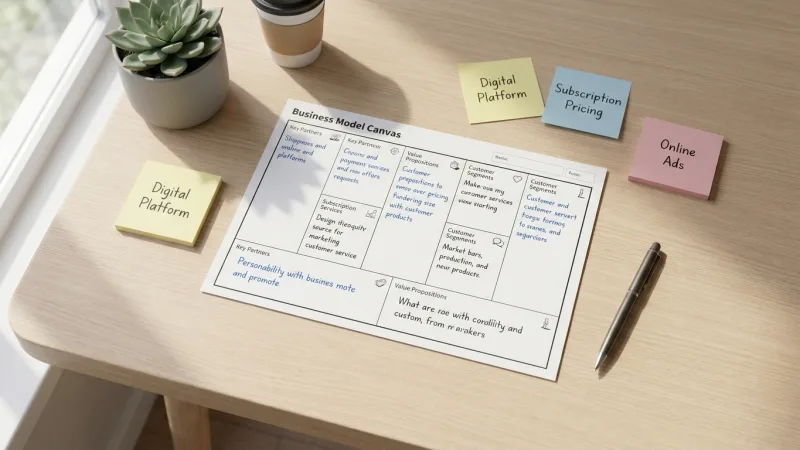
92% of startups that create a business plan fail, but companies using the Business Model Canvas have a 70% higher chance of scaling successfully. The difference? Validating assumptions, not just planning. Today, you’ll learn how to use the Business Model Canvas as a powerful validation framework. Expect a practical guide, fill-in templates with real B2B examples, and a step-by-step validation process that change theory into an executable strategy. Let’s dive into making your business vision a validated reality.
What Is the Business Model Canvas (And Why Most Founders Use It Wrong)
The Business Model Canvas (BMC) often gets misused as just another way to write a business plan. But that’s a mistake. 85% of startups fail due to poor market fit, not execution. The BMC is a validation framework designed to test your business assumptions against reality. Let’s look at why this difference matters.
Imagine pouring months into a traditional business plan only to see it collapse because you assumed customers wanted something they didn’t. The BMC prevents this by focusing on validation from the start. It’s about understanding, testing, and refining your business model as you go, not after the fact.
| Aspect | Business Model Canvas | Traditional Business Plan | Lean Canvas |
|---|---|---|---|
| Focus | Validation | Execution | Problem-Solution fit |
| Length | 1 Page | 20-40 Pages | 1 Page |
| Flexibility | High | Low | High |
| Goal | Revenue Model Testing | Business Plan Presentation | Startup Validation |
Let’s consider a failure example: A tech startup mapped out a beautiful BMC but treated it like a static plan rather than a dynamic tool. They overlooked customer feedback loops, resulting in a polished product nobody wanted. Don’t make the same mistake. Your BMC should be a living document, evolving with your business insights.
The 9 Building Blocks of Business Model Canvas (With B2B Examples)
Understanding each of the nine blocks of the Business Model Canvas is important for any B2B executive. Each part represents a critical element of your business model, and together they provide a complete view of how your company intends to create, deliver, and capture value.
Let’s break down these blocks with concrete B2B examples:
- Customer Segments: Identify your most important customers. Salesforce, for example, focuses on enterprise clients and SMBs, tailoring their CRM solutions to each.
- Value Propositions: What makes you different? HubSpot offers an all-in-one marketing platform that simplifies inbound marketing, a unique selling point for businesses overwhelmed by fragmented tools.
- Channels: How do you reach customers? Consider how Mailchimp uses both digital marketing and partnerships with e-commerce platforms to distribute its product.
- Customer Relationships: Engage and retain. LinkedIn uses a freemium model with premium tiers to build professional connections.
- Revenue Streams: Your income sources. Slack generates revenue through tiered subscription plans, catering to teams of all sizes.
- Key Resources: important assets. Zoom relies on its strong infrastructure and partnerships with hardware providers.
- Key Activities: Major tasks. Zoom continuously invests in improving its platform and user experience.
- Key Partnerships: Allies and collaborators. Microsoft Teams’ integration with Office 365 showcases powerful combination.
- Cost Structure: Critical expenses. For Dropbox, server storage and data management are significant costs.
Each block influences the others. For instance, your Channels must align with your Customer Segments to effectively deliver your Value Propositions. Misalignment here can cost you market opportunities.
Step-by-Step Business Model Canvas Template (Free Download)
Now it’s time to put everything into action with a practical Business Model Canvas Template. This isn’t just theory; it’s about execution. You can download our template and follow this order for maximum insights.
Start with these steps:
- Define Customer Segments first to ensure you’re addressing the right market.
- Develop a compelling Value Proposition that resonates with identified segments.
- Identify your Channels to effectively reach those customers.
- Determine Customer Relationships to decide how you’ll engage with your audience.
- Outline Revenue Streams to understand where your money will come from.
- List Key Resources important for delivering your value.
- Identify Key Activities that maintain your business operations.
- Establish Key Partnerships to use external strengths.
- Finally, map your Cost Structure to keep financials in check.
Each block comes with validation questions to test assumptions. Download our BMC template for more details.
Value Proposition Canvas Integration: Connect Customer Needs to Solutions
Integrating the Value Proposition Canvas (VPC) with your Business Model Canvas ensures that your solutions truly meet customer needs. It’s the missing link for a complete business design.
The VPC helps you dive deeper into understanding your customers’ jobs, pains, and gains. Combine this with the BMC to tailor your value propositions more effectively.
Conducting customer interviews is important for this process. Use our provided question framework to extract practical insights:
- What are their biggest pain points?
- How do they currently solve these problems?
- What would make their lives easier?
Map these findings to your VPC and ensure alignment with your BMC. This integration strengthens your business model by connecting customer needs directly to your offerings.
Real Business Model Canvas Examples: 3 Successful B2B Companies Analyzed
To see the Business Model Canvas in action, let’s analyze three successful B2B companies. Each offers lessons in adaptability and strategic pivoting.
- Company A (e.g., Salesforce): Initial focus on enterprise sales teams evolved to accommodate SMBs, resulting in a diversified revenue stream.
- Company B (e.g., HubSpot): Originally a CRM tool, HubSpot expanded to include a full marketing suite, a key pivot that led to significant growth.
- Company C (e.g., LinkedIn): Transitioned from a professional network to a professional services platform, expanding its market footprint.
Each change resulted in increased revenue. For instance, Salesforce’s SMB pivot led to a 30% revenue boost over two years. These examples demonstrate the canvas’s power when used dynamically.
Business Model Canvas Validation: Test Your Assumptions Before You Build
The most critical step in using the Business Model Canvas is validating your assumptions. Before investing time and resources, ensure your strategies align with market realities.
Use our assumption testing framework to guide your validation process:
- Identify key assumptions in your BMC.
- Design customer interview scripts to test these assumptions.
- Develop metrics to track validation success, such as customer acquisition cost and conversion rates.
By systematically testing assumptions, you can refine your model and avoid costly missteps. It’s about building confidence before committing resources.
Common Business Model Canvas Mistakes (And How to Avoid Them)
Even the best-intentioned teams can fall into common Business Model Canvas traps. Let’s tackle the top seven mistakes and how to recover from them.
- Overlooking customer feedback: Regularly update your canvas with new insights.
- Underestimating competition: Conduct thorough competitor analysis regularly.
- Being too rigid: Allow your canvas to evolve with market conditions.
- Ignoring cost structure: Regularly review costs to ensure profitability.
- Short-sighted customer relationships: Plan for long-term engagement strategies.
- Neglecting key partnerships: Continuously seek mutually beneficial partnerships.
- Failing to test assumptions: Validate all assumptions before scaling operations.
Implementing a strong validation framework will help you steer clear of these pitfalls. Remember, the Business Model Canvas is a tool for growth, not just planning.
Conclusion
If you’re ready to change your business idea into a validated strategy, it’s time to start using the Business Model Canvas as your blueprint. Download the free template today and begin validating your business model. Keep refining your approach, test your assumptions, and adapt as necessary. For more insights, explore our blog and our resources archive. Embrace the Business Model Canvas, and watch your business potential unfold.
What is a business model canvas? A business model canvas is a strategic management tool that outlines your company’s value proposition, infrastructure, customers, and finances on a single page. It allows for quick visualization and iteration of your business strategy, ensuring alignment and insight into your operations. How to fill out a business model canvas? Begin by identifying your customer segments, then outline your value propositions that cater to these segments. Follow up with defining channels, customer relationships, revenue streams, key resources, key activities, key partnerships, and finally, cost structure. This sequence helps in logically mapping out your business model. What’s the difference between Business Model Canvas and Value Proposition Canvas? The Business Model Canvas provides a macro view of your business model, while the Value Proposition Canvas zooms in on the relationship between your products/services and customer needs. Integrating both helps align your offerings with market demands effectively. How long does it take to complete a business model canvas? Completing a business model canvas can take anywhere from 1 to 3 hours, depending on the complexity of your business. The goal is to create a first draft quickly, which can then be refined and iterated upon as you gather more insights and feedback.