
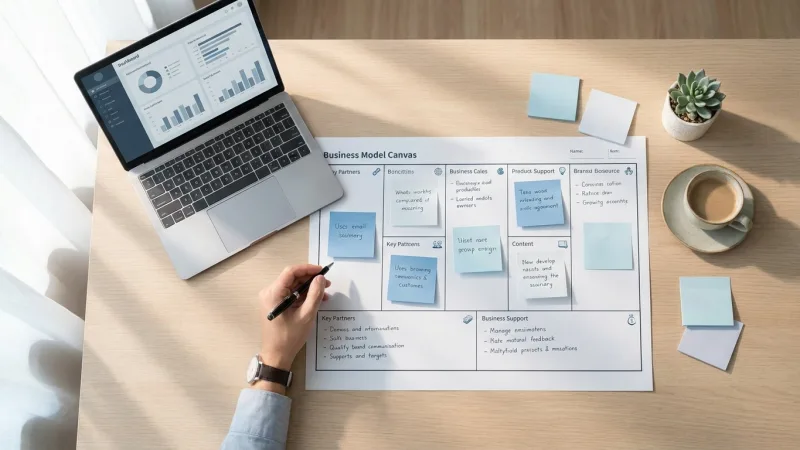
While 90% of startups create business model canvases, only 23% actually validate their assumptions with real customer data. That’s the difference between startups that merely exist and those that turn a one-page strategy into a million-dollar business. In this article, you’ll learn how to change your business model canvas into an practical execution roadmap with specific metrics and milestones, setting your enterprise up for flexible success. Plus, you’ll uncover how the canvas can prevent the $1.3 trillion wasted on failed products annually. Expect to walk away with a 5-step validation framework, real B2B examples, and a 90-day execution roadmap template. For related insights, check out our Business Model Canvas Guide: Map 9 Key Blocks in 1-3 Hours.
What is the Business Model Canvas: The Strategic Foundation
Alexander Osterwalder’s business model canvas is a potent tool for mapping out a business strategy. Unlike traditional business plans that take weeks to formulate, a canvas allows rapid iteration and validation. This difference is important, as 70% of startups fail without proper business model validation. Simply put, the canvas helps founders avoid the colossal $1.3 trillion wasted on products nobody wants. Want to explore 9 key blocks in just 1-3 hours? Dive into our guide here.
|
Aspect |
Traditional Business Plan |
Business Model Canvas |
|
Time to Create |
Weeks or months |
Hours |
|
Flexibility |
Rigid documentation |
Dynamic and visual |
|
Validation |
Often neglected |
Immediate and continuous |
As you can see, the canvas is quicker, more adaptable, and primed for constant validation. To grasp a 60-minute sprint framework, visit our Business Model Canvas Guide: 60-Minute Sprint Framework.
The 9 Building Blocks: Complete Framework Breakdown
Diving into the business model canvas means understanding its nine building blocks. Each segment is important, especially for B2B enterprises that often overlook specifics that can lead to strategic missteps. Let’s break each down with B2B examples you won’t find elsewhere.
|
Component |
B2B Example |
|
Customer Segments |
Targeting mid-sized manufacturers needing supply chain improve |
|
Value Propositions |
Providing cloud-based analytics that reduce operational costs by 35% |
|
Channels |
Using LinkedIn ads to reach decision-makers in tech firms |
Common mistakes? Overloading value propositions with jargon, or ignoring less obvious channels. Avoid these with our complete breakdown.
Data-Driven Canvas Creation: Validation Framework
Here’s where most B2B founders trip up, building assumptions without data validation. It’s critical to interview customers and meet minimum viable validation criteria before proceeding. This gap is why only 23% validate effectively.
Use this step-by-step validation checklist:
- Customer interviews: Conduct 12-15 interviews per segment using tailored question templates.
- Data analysis: Use a validation scorecard to evaluate findings.
- Pivot indicators: Identify red flags needing strategic shifts.
For interview question templates, see our 90-minute workshop structure guide.
Step-by-Step Canvas Completion Process
Filling out a canvas requires precision. To create immediate value, follow these steps in sequence, allocating specific times for each block. This concrete process suits B2B collaboration.
Here’s a 7-step completion framework with time-boxed agenda:
- Customer Segments: 15 minutes
- Value Propositions: 20 minutes
- Channels: 10 minutes
- Customer Relationships: 10 minutes
- Revenue Streams: 15 minutes
- Key Resources: 10 minutes
- Cost Structure: 10 minutes
improve this process with our guide on team collaboration best practices.
Real B2B Business Model Canvas Examples (3 Case Studies)
Concrete examples bring theory to life. Here are three B2B businesses that successfully implemented their canvas strategy.
Case Study 1: SaaS Company
This software firm used their canvas to target tech firms with a need for data security solutions. Post-implementation, revenue increased by 120%. They learned to focus on precise customer relationships.
Case Study 2: Manufacturing B2B
After identifying key resources and improve channels, this company saw a 40% rise in efficiency. A shift to more sustainable processes proved change.
Case Study 3: Professional Services
Aligning value propositions with the unique needs of legal firms, this service provider boosted client retention rates by 60%.
For detailed breakdowns, refer to our B2B strategy guide.
Canvas to Execution: Turning Strategy into Action
Turning your strategic canvas into practical initiatives is where many fail. Use an OKR (Objectives and Key Results) framework for execution aligned with your canvas sections.
Here’s a 90-day execution roadmap template:
- First 30 Days: Focus on validating revenue streams with hard data.
- Next 30 Days: improve channels and customer relationships.
- Last 30 Days: Adjust key activities based on learned insights.
Set success metrics for each block by use our B2B strategic planning framework.
Advanced Canvas Techniques: Iteration and Scaling
As your business grows, your canvas should evolve too. Advanced techniques involve versioning and scaling, missing from competitor content.
Here’s a canvas evolution timeline:
- Initial Phase: Single product focus
- Growth Phase: Multi-product canvas management
- Expansion Phase: International modifications
For scaling frameworks, check out B2B Blue Ocean Strategy: 15 Examples.
Common Pitfalls and How to Avoid Them
Top seven mistakes that can derail your canvas:
- Ignoring customer feedback in validation
- Inflexible channels strategy
- Overly broad customer segments
- Misaligned value propositions
- Poor cost structure awareness
- Neglecting key partnerships
- Failure to iterate the canvas regularly
Check your canvas health regularly using our resources archive.
Tools and Templates for Canvas Success
To implement your canvas effectively, use these tools and templates:
|
Tool |
Features |
|
Canvas Tool A |
Interactive modules, real-time collaboration |
|
Canvas Tool B |
Built-in analytics, cloud integration |
Downloadable templates are available on our resource archive. To see integration guides, visit our funding decision guide.
Frequently Asked Questions
What is a business model canvas?
A business model canvas is a strategic management tool that helps visualize key components of a business model on a single page. It allows teams to clearly outline customer segments, value propositions, channels, and more, build better communication and alignment. Unlike lengthy business plans, canvases are dynamic, help constant iteration based on real feedback.
How to fill out a business model canvas?
Begin by defining your customer segments and value propositions. Proceed to channels, customer relationships, and revenue streams. Complete with key resources, activities, partnerships, and cost structure. This order ensures a logical flow of strategy. Use decision-makers input and customer data for validation and iteration, ensuring accuracy and relevancy.
How long does it take to complete a business model canvas?
Completing a business model canvas typically takes between one to three hours, depending on the team’s familiarity with the business model framework. With focused workshops and clear guidelines, the process can be simplify, allowing for effective collection and analysis of strategic insights. Fast iteration cycles can further hasten the completion.
What’s the difference between business model canvas and business plan?
A business model canvas focuses on visual mapping of key business elements on one page, emphasizing flexibility and iterative validation. A business plan, however, is a complete written document outlining detailed business strategies, often requiring weeks to produce. Canvases encourage quicker adaptation and proactive strategy shifts.
Can you use business model canvas for existing businesses?
Absolutely, business model canvases are not limited to startups. They are useful for existing businesses to reevaluate strategies, adapt to market changes, and refine value propositions. Regular canvas iterations can reveal areas for improvement, drive innovation, and maintain competitive advantage.
Ready to make your business model canvas the engine of your strategic success? Today, start by validating one canvas section with real customer data, paving the way for a smarter strategy. Dive deeper into our home-based e-commerce business ideas for entrepreneurs or explore Valasys Business for more insights.