
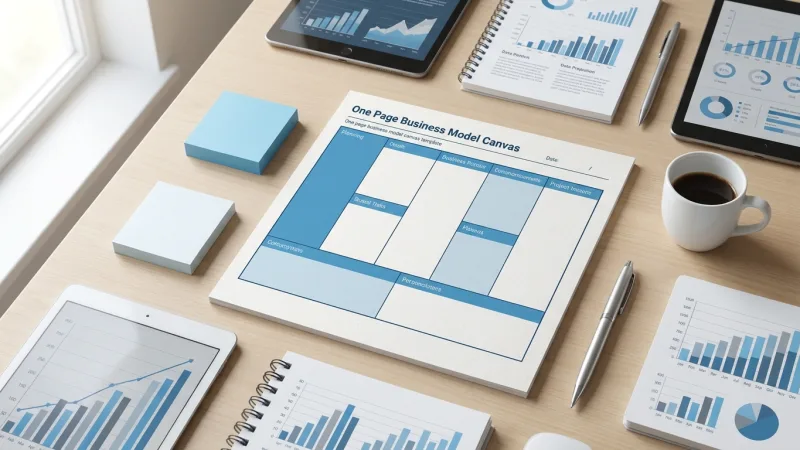
While 90% of startups fail due to poor business model decisions, companies using the Business Model Canvas are 3x more likely to successfully pivot when needed. Imagine turning this one-page tool into your strategic advantage. In this guide, you’ll learn how to validate each section of the canvas with real customer data, pivot based on findings, and change the canvas from a static plan into a dynamic business intelligence system. Ready to change your business strategy? You’re in the right place.
What is the Business Model Canvas and Why It Beats Traditional Business Plans
The Business Model Canvas (BMC) redefines business planning. Developed by Alexander Osterwalder, this framework distills your business model onto a single page, comprising nine building blocks. Where traditional plans can drown you in details, the BMC’s visual approach help quicker pivots, proven as 70% of startups using it adjust faster than traditional planners. Let’s break down why the BMC is your best strategic choice.
Imagine your SDR team gets 50 inbound leads on Monday morning. With a Business Model Canvas, you can efficiently strategize which value propositions appeal most. The visual thinking it encourages opens new avenues for B2B decision-making, ensuring everyone on your team is aligned and on the same page.
| Aspect | Business Model Canvas | Traditional Business Plan |
| Format | One-page visual document | 30-50 pages typically |
| Flexibility | High, easy updates | Low, needs complete overhaul |
| Focus | Strategic overview | Detailed planning |
| Time to Create | 1-3 hours | Weeks to months |
Business Model Canvas Guide: Map 9 Key Blocks in 1-3 Hours for more on quick BMC creation.
The 9 Building Blocks of the Business Model Canvas (With B2B Examples)
Diving into the BMC’s nine building blocks reveals its power. Each section must be filled with precision, offering a strong foundation for your strategy. Here’s a deeper look at each block, complete with real-world B2B examples.
1. Customer Segments
Understanding who you’re targeting is important. Identify not just who buys, but who benefits from your product. For a SaaS company like yours, consider segments such as enterprise IT departments and small business owners.
2. Value Propositions
This block differentiates you. What unique value do you offer? A SaaS example: “Reduce IT costs by 30% with our cloud management software.” It’s about solving real customer problems efficiently.
3. Channels and Customer Relationships
Determine how you’ll reach your customers and maintain relationships. Are webinars or direct sales your approach? If you’re targeting startups, maybe an online self-service model works best.
4. Revenue Streams
Define how your company makes money. Is it through subscriptions, licensing, or perhaps freemiums? The key is diversification, don’t rely on a single stream.
5. Cost Structure
Identify your major costs and classify them accordingly. Fixed costs vs. variable ones should be carefully analyzed to maintain lean operations.
6. Key Resources
List out all critical resources, technology, people, and finances. SaaS companies need a strong cloud infrastructure and a talented development team.
7. Key Activities
What activities are important to delivering your value proposition? For you, that might be software development, customer support, and marketing efforts.
8. Key Partnerships
Form alliances that strengthen your offerings. Think of strategic partnerships with cloud providers or technology consortiums.
9. Customer Interviews
Engage directly with your customer base. This feedback is gold for validating and improving your canvas.
Map Your B2B Business: 5-Step Model Canvas Guide for Startups for a complete understanding of each block.
| Building Block | Common Mistakes |
| Customer Segments | Failing to identify distinct segments leads to diluted strategies. |
| Value Propositions | Generic propositions that don’t stand out in the market. |
| Channels | Overreliance on a single channel limits reach. |
Step-by-Step: How to Fill Out Your Business Model Canvas (The Validation Method)
Filling out your canvas is only half the battle. Validation is where the BMC truly change. Here’s how to ensure each block stands up to scrutiny and adapts based on real data.
Step 1: Start with Assumptions
Begin by listing your assumptions for each block. Challenge these with data before marking them as facts.
Step 2: Engage in Customer Interviews
Direct customer feedback is invaluable. Ask questions that uncover needs, not just confirmations of your ideas.
Step 3: Test Value Propositions
Before launching, A/B test your propositions to fine-tune what resonates best.
Step 4: Iteration Cycles
Set regular intervals to revisit each block. What have you learned, and how should your strategy pivot?
Follow our Business Model Canvas: 9-Block Framework for Startups for a tested validation process.
Here’s a 7-step validation process framework you can download:
Advanced BMC Strategies: Using the Canvas for Strategic Pivots and Growth
Once the fundamentals are in place, improve your BMC use. change it into a live document that guides strategic growth and pivots.
Quarterly Canvas Reviews
Schedule reviews every quarter to evaluate each block’s relevance. Stay ahead of industry shifts and adapt smooth.
Identifying Growth Bottlenecks
Analyze your canvas to pinpoint where growth is stalling. A strong diagnostic framework helps here.
Multi-Canvas Approach
For businesses targeting multiple segments, maintain separate canvases. This ensures tailored approaches for diverse audiences.
Canvas-to-OKR Alignment
Align your canvas insights with Objectives and Key Results (OKRs) to track and achieve strategic goals.
Why I Believe Every Business Should Pursue Business Model Innovation offers insights into integrating BMC with company-wide strategies.
Business Model Canvas Template and Tools (Free Download + Software Options)
To get started, download our free BMC template. If you’re looking for digital tools to improve collaboration, here’s a comparison of top options.
Collaborative Canvas Platforms
Platforms like Miro or Creately are great for remote teams. They integrate well with tools you already use, improving the collaborative experience.
| Tool | Features | Best For |
| Miro | Real-time collaboration, templates | Remote teams |
| Creately | Drag-and-drop interface, integrations | Visual planners |
Value Proposition Canvas Integration: Zooming Into Your Most Critical Block
The Value Proposition Canvas is an invaluable extension of the BMC, zooming into customer needs, pains, and gains. It’s your key to achieving true product-market fit.
Mapping Customer Jobs, Pains, and Gains
Break down your customers’ tasks and challenges. How does your solution alleviate pains and highlight gains?
Product-Market Fit Through Integration
Once integrated, the Value Proposition Canvas provides clear insights into aligning products with market demand, ensuring your offerings remain relevant.
B2B Testing Methods
Implement A/B tests and pilot programs to refine your value propositions, ensuring they meet customer needs effectively.
For a template and detailed walkthrough, see our Home-Based E-Commerce Business Ideas for Entrepreneurs.
Real Business Model Canvas Examples: 5 Successful B2B Companies Analyzed
Nothing compares to seeing how successful companies apply these principles. Here’s how five B2B giants have use their Business Model Canvas.
Salesforce
Examine Salesforce’s BMC for insights into how it structured its customer relationships and value propositions, setting industry standards.
Slack’s Pivot
Slack’s pivot from a failing game company to a workplace communication tool is a textbook example of strategic change.
Zoom’s Pandemic Adaptation
Zoom adjusted its BMC to cater to the explosive demand during the pandemic, showcasing agile business planning.
HubSpot’s Freemium Model
Dive into HubSpot’s canvas to learn how a freemium model can be sustained and profitable.
Shopify’s Platform Evolution
See how Shopify’s incremental evolutions in its BMC have kept it at the forefront of e-commerce.
Each example provides practical insights and strategic learnings. Our summary table below highlights key takeaways for your canvas development.
| Company | Key Learning |
| Salesforce | Strong customer relationships drive sustainable growth. |
| Slack | Pivoting can change failure into success. |
| Zoom | Agility in business adaptation is important. |
Conclusion
Today, take the first step towards a dynamic business strategy. Download your free Business Model Canvas template and start mapping out your business model on a single page. Remember, this isn’t just a plan; it’s a tool for ongoing strategic refinement and growth. Use it to position your company not just to survive, but to lead in your industry.
For further reading, explore our Blogs and see why E-commerce business on Autopilot: Tools & Strategies could be your next big step. As business market continue to evolve, those who adapt will thrive.
What is a business model canvas? The Business Model Canvas is a strategic management tool that provides a visual framework for developing, describing, and pivoting business models. It helps entrepreneurs lay out their business’s core components on a single page, help quick decision-making and strategic clarity. How to fill out a business model canvas? Start with assumptions, engage in customer interviews, and test your hypotheses. Proceed to validate each block using real data. This ensures your business model is not just a plan but a dynamic guide that adapts based on market feedback and internal insights. What’s the difference between Business Model Canvas and Value Proposition Canvas? The Business Model Canvas outlines the overall structure of a business, encompassing everything from customer segments to revenue streams. The Value Proposition Canvas focuses specifically on the value exchange between your business and its customers, detailing jobs, pains, and gains. How often should I update my business model canvas? Regular updates ensure relevance and strategic alignment. Perform quarterly reviews and make updates whenever significant internal or market changes occur. This practice keeps your business model responsive and proactive in a dynamic business environment.