
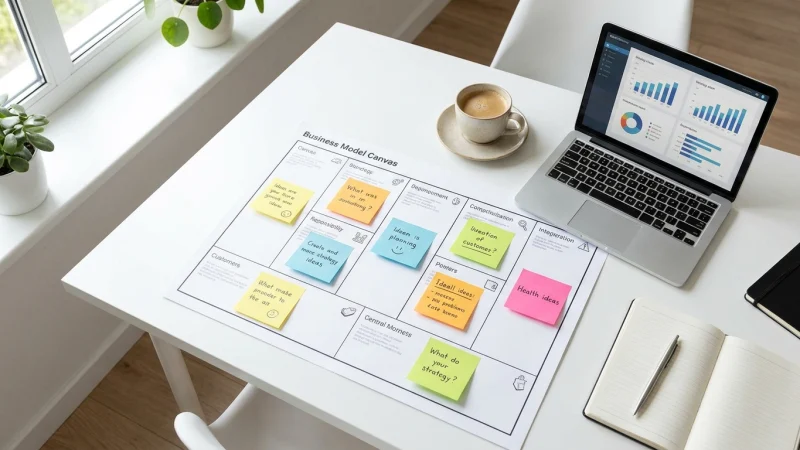
73% of startups create a Business Model Canvas, but only 12% use it correctly as a living validation tool rather than a static planning exercise. This reality leads to unnecessary failure, time wasted, and competitors gaining ground. If you’re determined to buck this trend, you’ll want to dive into our complete guide, which arms you with a 9-step validation framework for each canvas block, enriched with real startup examples and common failure patterns to steer clear of. Let’s turn your canvas into a functional map that guides your business to success.
What is the Business Model Canvas (And Why 73% of Startups Use It Wrong)
The Business Model Canvas (BMC), developed by Alexander Osterwalder, is a strategic management template used for developing new business models. It offers a single-page snapshot of your business, comprising nine key components that together form the backbone of your business strategy. However, despite its potential, 73% of startups misuse it by treating it as a static document rather than an iterative tool.
The misconception often lies in the difference between a business plan and a Business Model Canvas. While a business plan is detailed and narrative, a BMC is concise and visual. This difference is important, as the BMC encourages ongoing validation and iteration. Understanding this distinction can significantly impact your startup’s survival rate, which currently stands at a mere 50% beyond five years.
|
Aspect |
Business Plan |
Business Model Canvas |
|
Length |
20-50 pages |
1 page |
|
Detail |
In-depth description |
High-level overview |
|
Purpose |
Funding applications |
Strategy alignment |
|
Flexibility |
Rigid |
Highly adaptable |
The right approach is to see the BMC as a dynamic tool, one you revise regularly to reflect the current state and future direction of your business. By doing so, you change it from a mere organizational chart into a living document that truly guides your strategic decisions.
The 9 Building Blocks of Business Model Canvas (Complete Breakdown)
Before diving into the completion of your Business Model Canvas, you must understand the individual building blocks. Each block represents a fundamental aspect of your business, and collectively, they illustrate the flow of value from your company to your customers. The order in which you fill out these blocks can also impact your results, guiding you through a logical process from customer segments to key partners.
Let’s break down these components:
- Customer Segments: Who you’re creating value for.
- Value Propositions: What makes you unique and worth buying.
- Channels: How you deliver value to your customers.
- Customer Relationships: How you interact with customers before, during, and after sales.
- Revenue Streams: How you earn money.
- Key Resources: Assets required to deliver your value.
- Key Activities: important actions for your business model.
- Key Partnerships: Outside entities you rely on.
- Cost Structure: All costs involved in operating your business.
The left side of the canvas focuses on internal efficiency, while the right side deals with external value and market presence. Balancing both sides effectively is key to a successful business model. Understanding the interdependency of these blocks and the flow from one to the other helps ensure no aspect of your business model is neglected.
Step-by-Step BMC Completion Guide (With Validation Questions)
Creating a Business Model Canvas isn’t just about filling in the blocks; it’s about asking the right questions and validating your assumptions at every step. Below is a step-by-step guide on completing each block, along with key validation questions and red flag indicators.
- Customer Segments: Who are your most important customers?
- Validation Question: What problem are you solving for them?
- Red Flag: Answer based on assumptions without customer interviews.
- Value Propositions: Why do customers buy from you?
- Validation Question: What unique benefit do you offer?
- Red Flag: Value proposition is generic or untested.
- Channels: How do you reach your customers?
- Validation Question: Which channels are most cost-effective?
- Red Flag: Reliance on a single channel without ROI measurement.
- Customer Relationships: How do you maintain customer interaction?
- Validation Question: What level of relationship do your customers expect?
- Red Flag: Ignoring customer feedback and engagement metrics.
- Revenue Streams: How do you generate income?
- Validation Question: What are customers willing to pay?
- Red Flag: Lack of flexible pricing models or diverse revenue streams.
- Key Resources: What resources are critical for delivering your value?
- Validation Question: Are these resources flexible with growth?
- Red Flag: Dependence on resources outside of your control.
- Key Activities: What activities are important to your business?
- Validation Question: Which activities drive the most value?
- Red Flag: Activities not aligned with business strategy.
- Key Partnerships: Who are your important partners?
- Validation Question: How do partners contribute to your success?
- Red Flag: Partnerships that do not improve competitive advantage.
- Cost Structure: What are your primary expenses?
- Validation Question: Are your costs aligned with revenue and value delivery?
- Red Flag: Lack of cost control or hidden expenses.
|
Block |
Validation Questions |
Red Flags |
|
Customer Segments |
What problem are you solving for them? |
Assumption-based answers |
|
Value Propositions |
What unique benefit do you offer? |
Generic value proposition |
|
Channels |
Which channels are most cost-effective? |
Single-channel reliance |
|
Customer Relationships |
What level of relationship is expected? |
Ignoring feedback |
|
Revenue Streams |
What are customers willing to pay? |
Lack of diverse streams |
|
Key Resources |
Are these resources flexible? |
External resource dependence |
|
Key Activities |
Which activities drive value? |
Misaligned activities |
|
Key Partnerships |
How do they contribute to success? |
Weak competitive partnerships |
|
Cost Structure |
Are costs aligned with revenue? |
Hidden expenses |
Iteration checkpoints throughout this process ensure you’re not just filling out boxes but validating and refining as real-world data comes in. This approach not only assists in perfecting your model but also protects against costly mistakes.
Real Business Model Canvas Examples (3 Different Industries)
To illustrate the flexibility and applicability of the Business Model Canvas, let’s explore examples across three diverse industries: SaaS, E-commerce, and Service-based businesses. Each example demonstrates unique strategic insights and critical success factors.
SaaS Startup Example
A SaaS company offering project management software to SMEs capitalized on smooth integrations and a freemium model to attract and retain customers. Their key activities included strong R&D and customer support, while their main resource was a skilled development team.
E-commerce Business Example
An online retailer specializing in eco-friendly products targeted conscious consumers via social media channels and partnerships with green influencers. Their cost structure leaned heavily on marketing and logistics, reflecting their value-driven approach.
Service-Based Business Example
A consultancy firm focusing on digital change for traditional businesses maintained deep customer relationships through personalized service packages. Key partnerships with tech experts enabled them to deliver new solutions at competitive prices.
Each example showed a clear understanding of their value propositions, aligned with their chosen customer segments, and showed strategic use of key partnerships to improve their competitive edge.
Common Business Model Canvas Mistakes (And How to Avoid Them)
Even with a perfect canvas, common pitfalls can derail your strategic efforts. Here are the top seven Business Model Canvas mistakes and how to avoid them:
- Overlooking Customer Feedback: Consistently collect and integrate customer insights.
- Ignoring Competitors: Regularly analyze competitors to refine your value proposition.
- Static Canvas Use: Update your canvas quarterly to keep it relevant.
- Unclear Value Proposition: Clearly articulate how you solve unique customer problems.
- Underestimating Costs: Use detailed financial projections to anticipate all expenses.
- Poor Channel Strategy: Diversify channels and measure performance rigorously.
- Weak Partner Relationships: Build strong partnerships that provide strategic advantages.
By recognizing these common errors, you can refine your business model and avoid setbacks that can impede growth.
BMC Templates and Tools (Free Downloads + Software Options)
Having the right tools can significantly improve the effectiveness of your Business Model Canvas. Here are some free templates and software options:
- Canvanizer: Offers an online collaborative platform for creating and sharing BMCs.
- Strategyzer: Provides digital tools for real-time collaboration and strategic insights.
- Miro: Features an intuitive interface for building dynamic canvases with team input.
|
Tool |
Features |
Best For |
|
Canvanizer |
Online collaboration, easy sharing |
Teams needing basic functionality |
|
Strategyzer |
Strategic insights, real-time updates |
Businesses needing advanced analytics |
|
Miro |
Dynamic interface, team collaboration |
Creative teams with visual focus |
These tools not only provide structure but also help collaboration, making it easier to keep your canvas a living document.
Beyond the Canvas: Testing and Iterating Your Business Model
Your Business Model Canvas should never sit untouched; it’s a tool for ongoing testing and refinement. Integrating approaches like the Lean Startup methodology allows you to pivot based on practical metrics rather than assumptions.
Create a quarterly review schedule to assess each block’s performance. Metrics such as customer acquisition cost and time to market can provide insights into efficiency and effectiveness. By consistently iterating, you position your business for sustainable success.
Testing methodologies and frameworks can significantly improve how you use your Business Model Canvas. By using data-driven strategies, you ensure that your business model adapts to market changes and internal growth, maintaining its relevance and effectiveness.
Conclusion
Today, take action by downloading a free Business Model Canvas template and schedule your first brainstorming session to kickstart your business model refinement process. Use the 5-step model canvas guide to map your path to success. Remember, your Business Model Canvas is a living tool that, when used correctly, can change your strategic planning and execution.
Prepare for a future where continuous improvement keeps your business model aligned with your vision and market demands. Now’s the time to make your canvas a dynamic tool for growth.
What is a business model canvas? The Business Model Canvas is a strategic management tool that outlines the important elements of a business model on a single page. It helps businesses visualize and align their activities by illustrating potential trade-offs and priorities. How to fill out a business model canvas? To fill out a Business Model Canvas, start with identifying customer segments, then define value propositions, channels, customer relationships, revenue streams, key resources, key activities, key partnerships, and cost structure. Validate each block with data and iterate based on feedback. What’s the difference between business model canvas and business plan? The Business Model Canvas is a high-level overview of your business model on a single page, flexible for iterative updates, while a business plan is a complete, detailed document used mainly for funding purposes and tends to be more static. How often should you update your business model canvas? You should update your Business Model Canvas quarterly, or more frequently if there are significant changes in your business environment or strategy, to ensure it remains a relevant and practical tool for strategic planning.