
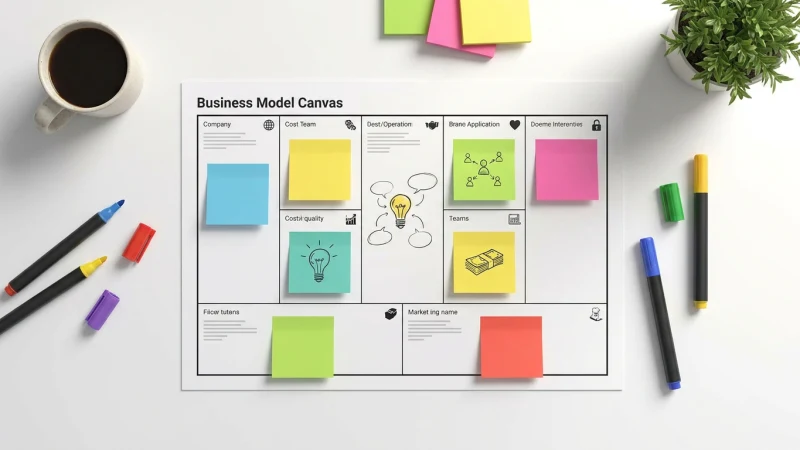
Did you know 73% of companies that create a Business Model Canvas never actually implement it? The best approach to turn your canvas into a revenue-generating tool in 90 days lies in a systematic execution plan. In this article, we’ll demystify the Business Model Canvas, revealing the secret sauce to its successful application, common pitfalls, and a step-by-step blueprint to ensure your canvas doesn’t just gather dust on a shelf.
What Is the Business Model Canvas (And Why 90% Get It Wrong)
The Business Model Canvas, conceived by Alexander Osterwalder, was designed to offer a clear, visual way to represent your business model on a single page. Yet, 90% of businesses misuse it, treating it like a static document instead of a dynamic tool. Imagine trying to assemble a jigsaw puzzle with half the pieces missing. That’s what happens when companies fail to fully integrate each element of the canvas.
Statistically, only 27% of businesses successfully implement their Business Model Canvas. This figure drops even lower for small businesses with less than 50 employees. The canvas is not just a lighter version of a business plan, it’s a strategic framework that requires continuous iteration.
Let’s compare a Business Model Canvas with a traditional business plan to understand its unique value:
| Criteria | Business Model Canvas | Traditional Business Plan |
| Document Length | 1 Page | 20-100 Pages |
| Flexibility | High | Low |
| Update Frequency | Ongoing | Yearly |
To use the Business Model Canvas effectively, you must see it as an evolving blueprint rather than a finished product. This perspective shift alone can increase the success rate of your canvas implementation significantly.
The 9 Building Blocks: Your Complete Business Architecture
The foundation of any successful business model lies within the nine building blocks of the Business Model Canvas, a concept that many guides gloss over but is important for your success. Understanding each block and how they interconnect is important.
Let’s break them down with practical examples:
- Customer Segments: Clearly identify whom you’re creating value for. A startup targeting small businesses might prioritize flexibility and cost-efficiency in its offerings.
- Value Propositions: What makes you stand out? Perhaps you offer a 24-hour customer service guarantee when competitors don’t.
- Channels: How do you reach your customers? A direct sales force might work well, but digital channels can often amplify reach.
Each building block can make or break your canvas. For instance, a weak value proposition can dilute customer interest, while poorly defined customer segments can lead to wasted marketing efforts. Here’s an error checklist to ensure each block is strong:
| Building Block | Common Mistakes |
| Customer Segments | Targeting too broad an audience |
| Value Propositions | Too generic or not customer-centric |
| Channels | Over-reliance on a single channel |
Use this checklist as a guiding tool to refine your canvas, ensuring each component works cohesively for a stronger business model. For more on structuring your B2B model, check out our 5-step model guide.
The 90-Minute Canvas Workshop Method (Step-by-Step)
Executing a Business Model Canvas doesn’t have to be a drawn-out process. The 90-minute workshop method offers a simplify approach to develop a practical canvas in the shortest time possible.
Here’s a minute-by-minute breakdown of a successful session:
- 0-10 Minutes: Set objectives and clarify the purpose of the canvas. Use this time to align the team on the end goal.
- 10-30 Minutes: Customer Segments and Value Propositions. Encourage brainstorming and engage in vivid discussions.
- 30-50 Minutes: Channels and Customer Relationships. Map out how you’ll reach and retain your customers effectively.
Facilitation techniques can greatly vary depending on team size. Smaller teams of 5 or fewer might benefit from a more collaborative approach, while larger groups should focus on structured input and moderated discussions. Here’s a workshop template to guide your session:
| Time | Activity |
| 0-10 Minutes | Introduction and Objectives |
| 10-30 Minutes | Customer Segments & Value Propositions |
| 30-50 Minutes | Channels & Relationships |
| 50-70 Minutes | Revenue Streams & Key Resources |
| 70-90 Minutes | Refinement and Next Steps |
Before your workshop, make sure to prepare with the right materials, a large canvas template, sticky notes, markers, and any necessary customer data. This preparation is critical for an effective session.
Value Proposition Canvas Integration: The Missing Link
Integrating the Value Proposition Canvas (VPC) with your Business Model Canvas (BMC) is often overlooked but can increase customer acquisition by 40%. The VPC is your go-to tool for ensuring your value propositions align with customer needs.
Here’s how you can integrate them effectively:
- Map Customer Segments in the BMC with the VPC’s Customer Jobs. This ensures alignment between what customers need and what you’re offering.
- Align Value Propositions to Customer Pains and Gains. Use the VPC to identify key pain relievers and gain creators.
- Iterate Continuously. Constantly refine based on feedback and market changes.
Consider the case of a retail SaaS provider that saw a 40% improvement in customer acquisition after aligning its VPC and BMC. They discovered potential gaps in their value proposition that were addressed through targeted product offerings.
7 Critical Validation Tests Before You Launch
Before you hit the market, subjecting your Business Model Canvas to rigorous tests can save you from costly missteps.
Here are seven validation tests you should conduct:
- Customer Interviews: Validate assumptions with direct feedback from target customers.
- Competitive Analysis: Ensure your unique value proposition stands out.
- Cost Structure Analysis: Confirm your cost assumptions with actual quotes and vendor discussions.
Look for red flags such as non-differentiated value propositions or unclear customer segments. Use a validation scorecard to objectively measure each element.
| Validation Test | Score (1-5) |
| Customer Interviews | |
| Competitive Analysis | |
| Cost Structure Analysis |
If you find weak areas, use a decision tree to decide on revisions or pivots. Consistent validation helps maintain a competitive edge, enabling more strategic process mapping and operational success.
Industry-Specific Canvas Variations and Templates
Not all business models are created equal. Tailoring your Business Model Canvas to your industry can provide significant advantages.
Consider the following variations:
- SaaS: Focus on recurring revenue models and digital channels.
- E-Commerce: Emphasize distribution channels and customer experience.
- Consulting: Highlight key partnerships and unique knowledge.
For B2B and B2C businesses, these differences can be important. A SaaS B2B might prioritize customer support and integration capabilities, whereas a B2C e-commerce would focus on user experience and brand loyalty.
| Industry | Key Emphasis |
| SaaS | Subscription and Support |
| E-Commerce | Logistics and Customer Experience |
| Consulting | Expertise and Partnerships |
For industry-specific templates, download our set of five major business type canvases that are tailored for distinct operational focuses. This customization can be a game-changer, especially for niche markets.
From Canvas to Execution: The 30-60-90 Day Action Plan
The final step is converting your Business Model Canvas into practical steps. The 30-60-90 day plan bridges the gap between theory and practice.
In the first 30 days, focus on quick wins and easy adjustments. For instance, you might refine your Value Proposition or improve your online channels. By the 60-day mark, you should implement core strategic changes, like onboarding key partnerships.
Finally, the 90-day mark is for review and iteration. Measure progress against KPIs mapped out for each building block. This structured approach will ensure your business model remains dynamic and responsive to the market.
For a detailed KPI tracking framework and action plan templates, view our home-based e-commerce ideas to see how similar strategies are applied.
What is a business model canvas? The Business Model Canvas is a strategic management tool that provides a visual chart with elements describing a company’s value proposition, infrastructure, customers, and finances. Created by Alexander Osterwalder, it helps businesses align activities by illustrating potential trade-offs. How to fill out a business model canvas? To fill out a Business Model Canvas, start by identifying the nine key components: customer segments, value propositions, channels, customer relationships, revenue streams, key resources, key activities, key partnerships, and cost structure. Use sticky notes for flexibility, and iterate based on feedback. How long does it take to complete a business model canvas? Completing a Business Model Canvas can take anywhere from 90 minutes in a structured workshop to several days, depending on the complexity of the business and the depth of detail required. It’s a dynamic document meant to be continuously revisited and refined. What’s the difference between business model canvas and lean canvas? The Business Model Canvas focuses on a broader range of business operations including customer segments and revenue streams, while the Lean Canvas, developed by Ash Maurya, emphasizes startup methodologies and adaptability, focusing more on problem-solving and customer problems.
To ensure your Business Model Canvas doesn’t join the 73% that languish unimplemented, start by downloading our templates and launching your 90-day action plan today. The future of your business deserves this foundation.
Embrace this approach, and you’ll not only map your business effectively but also set the stage for sustainable growth in the ever-evolving market. In 2024, those who perfect their canvas execution will lead the pack in innovation and success.