
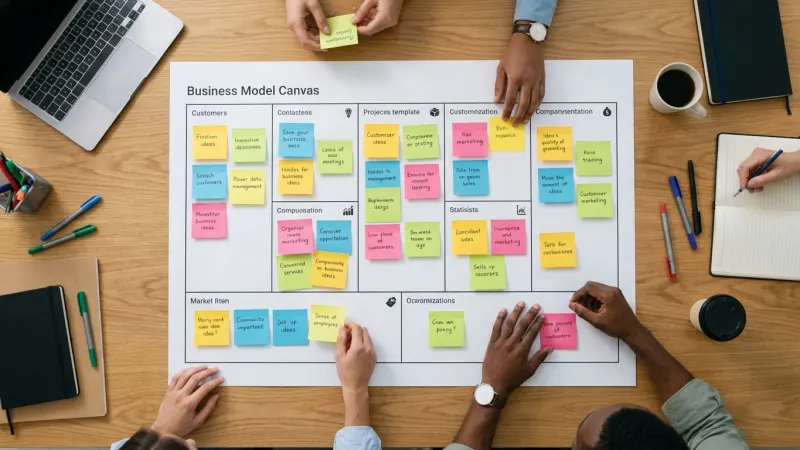
Did you know 73% of startups fail because they build products nobody wants? Yet, companies that survive share a secret: they validate their business model before writing a single line of code. Imagine if you could avoid costly pivots and wasted resources by mapping out your business on one page. In this business model canvas guide, you’ll discover how to validate each section with real data and metrics before diving into execution.
Why 73% of Startups Fail Without a Validated Business Model Canvas
Skipping proper business model design can cost you more than just time. According to CB Insights, failing to validate your model can lead to unexpected pivots that sink 73% of startups. But early validation can save your startup from a costly downfall.
| Failure Reason | Percentage |
| No Market Need | 42% |
| Ran Out of Cash | 29% |
| Wrong Team | 23% |
Pivoting late can cost a startup $1M+ in lost funding and opportunity. But early validation, such as pre-launch customer interviews or MVP testing, can cut costs by 60% and significantly improve strategic planning ROI.
The cost of a pivot after launch often exceeds the initial investment. Validating your business model canvas not only reduces this risk but ensures your team aligns on strategy from the start, increasing the likelihood of long-term success. Read more about eliminating operational bottlenecks to simplify processes.
The 9 Building Blocks: Your Complete Business Model Canvas Template
If you’ve ever been confused about what each section of the business model canvas (BMC) entails, you’re not alone. Let’s break it down.
The BMC consists of nine building blocks: Customer Segments, Value Propositions, Channels, Customer Relationships, Revenue Streams, Key Resources, Key Activities, Key Partnerships, and Cost Structure. Each block requires specific validation to ensure your business model will thrive.
Common mistakes like underestimating costs or overestimating revenue are frequent. For instance, 67% of B2B firms incorrectly forecast their revenue streams. Let’s dive into how to avoid this by validating each section with data.
| Building Block | B2B Example | Validation Question |
| Customer Segments | SaaS targeting mid-sized tech companies | Have you identified the decision-makers? |
| Channels | Direct sales through a B2B sales team | Does your cost of customer acquisition align with your pricing model? |
For a deeper understanding, access our B2B business model canvas guide which offers a detailed 5-step model for startups.
Step-by-Step: Fill Out Your Business Model Canvas in 60 Minutes
What if you could draft your entire business model in just an hour? Here’s how to do it.
Start with a 60-minute workshop, breaking down each BMC section into 10-minute exercises. Use prompts to guide your thinking, such as “Who are your top three customer segments?” Then, use a worksheet to structure your responses.
- 10 Minutes: Define Customer Segments
- 10 Minutes: Articulate Value Propositions
- 10 Minutes: Identify Key Channels
Let’s walk through a live B2B SaaS example: Imagine you’re a startup offering a SaaS platform for remote team management. Your first task is to define your primary customer, likely HR managers in tech firms. Next, ensure your value proposition speaks directly to their needs.
By the end of the session, you should have a clear, practical BMC that your team can align on and execute. For more strategic insights, explore our article on business model innovation.
Validation Framework: Test Your Assumptions Before You Build
Validation is the linchpin of a successful business model. Before committing resources, test assumptions with real data and feedback.
Implement customer interviews to validate your customer segments and value propositions. Track metrics such as customer acquisition cost and lifetime value to ensure financial sustainability. Consider setting up MVPs to test your value propositions in the market.
| Validation Method | Canvas Section | Metric to Track |
| Customer Interviews | Customer Segments | Interview Conversion Rate |
| MVP Testing | Value Propositions | Customer Feedback Score |
Use our e-commerce insights to further explore customer feedback strategy. For B2B, tying these metrics to your overall strategy will anchor your business model in reality.
Advanced Canvas Techniques: Scenario Planning and Pivot Strategies
Scenario planning and pivot strategies are often overlooked but important. What if your primary customer segment loses funding, or your main channel becomes obsolete?
Create multiple business model scenarios to anticipate changes. A pivot decision framework will help determine when to stick with your plan or make necessary changes based on performance metrics and market shifts.
| Scenario Type | Trigger Event | Action |
| Loss of Key Partner | Partner exits market | Identify alternative partnerships |
| New Competitor | Launch of disruptive product | Revise competitive positioning |
For more on strategic pivots, check out our guide on bootstrapping vs venture capital. Preparing for different scenarios ensures your business can adapt quickly to external changes.
Digital Tools and Templates: Canvas Creation and Collaboration
Incorporating digital tools into your BMC process improve collaboration and ensures continuity.
Explore tools like Miro and Canva for collaborative digital canvases. These platforms enable version control, real-time collaboration, and integration with other business planning tools.
| Tool | Feature | Best For |
| Miro | Real-time collaboration | Remote teams |
| Canva | Template design | Visual presentation |
Implement team collaboration practices to keep everyone aligned. For instance, regular review meetings can ensure your BMC remains relevant and up-to-date. Our article on automation in e-commerce can offer insights on integrating other planning tools.
From Canvas to Execution: Turning Strategy into Action Plans
The gap between strategy and execution is where many plans falter. Aligning your business model canvas with OKRs can bridge this gap.
Map each section of your canvas to specific OKRs. This ensures every team member knows their role in achieving strategic goals. Develop a resource allocation framework to distribute resources effectively and create a 90-day action plan to track progress.
Measuring success through defined metrics will show whether your strategic plans are paying off. Explore our PR strategies to further align your public relations with business goals.
Now, it’s time to take action. Start by validating one section of your BMC today. For more detailed guidance, explore Valasys Business for resources and insights that help fuel your strategic success.
FAQ
What is a business model canvas?
A business model canvas is a strategic management tool that provides a complete visual chart to describe, design, and analyze the main aspects of a business model. It includes nine important components to simplify the strategic overview on a single page.
How to fill out a business model canvas?
To fill out a business model canvas, start by identifying your customer segments and value propositions. Then, detail the channels, customer relationships, revenue streams, key resources, key activities, key partnerships, and cost structure. Use data and customer feedback to validate each section.
How long does it take to complete a business model canvas?
Completing a business model canvas can take as little as 60 minutes using a structured workshop approach, where each section is divided into focused exercises. This quick method helps ensure clarity and team alignment in the initial strategic planning phase.
What’s the difference between business model canvas and value proposition canvas?
The business model canvas provides a broad overview of a business’s infrastructure, target customer, and financial aspects, while the value proposition canvas focuses specifically on detailing the unique value a company offers to its customers and how it fulfills their needs.