
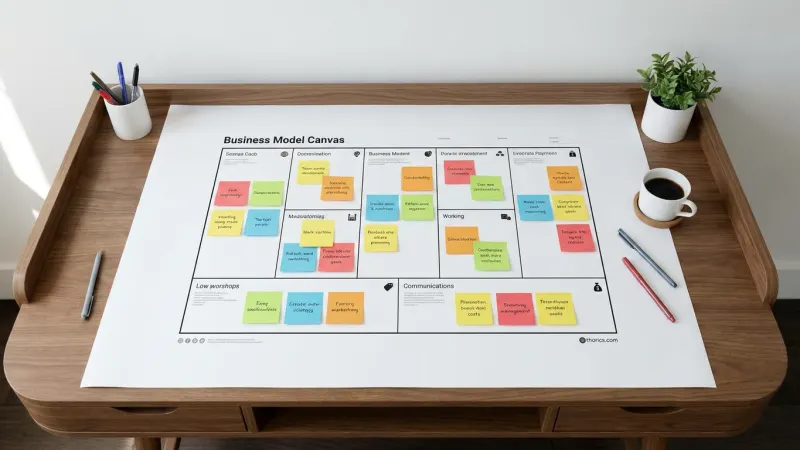
While 73% of startups create a Business Model Canvas, only 27% use it as the dynamic strategic tool it was designed to be. If you’re among the 46% whose BMCs end up as static documents collecting dust, it’s time to pivot. This Business Model Canvas guide will walk you through a complete 90-minute workshop format using real startup examples, show you common failure patterns, and provide iterative refinement strategies. You’ll turn your BMC from a one-time exercise into a living, breathing tool that drives your business forward.
Why 73% of Business Model Canvases Fail (And How to Beat the Odds)
The cold reality is that most Business Model Canvases (BMCs) are doomed from the start. A staggering 73% of them fail because they are treated as static documents rather than dynamic tools. The common culprits? Oversimplification, lack of iteration, and failure to involve key decision-makers. Let’s examine why these practices lead to failure and how you can avoid these pitfalls.
The first mistake is oversimplification. Founders often create a BMC and expect it to cover every nuance of their business strategy without further development. Imagine your sales team receiving 100 leads but only contacting each one once. That’s how a static BMC operates.
Let’s use a real failure story to illustrate this. A tech startup, aiming to change office communication, crafted a BMC that initially impressed investors. However, they failed to update key partnerships and revenue streams as their business environment changed. Within 18 months, they found themselves overshadowed by more agile competitors.
|
Successful BMC Approaches |
Failed BMC Approaches |
|
Regular Updates |
Static Document |
|
Inclusive Team Feedback |
Founder-Only Creation |
|
Validated Assumptions |
Unverified Guesses |
To consistently beat the odds, integrate your BMC into your regular strategy discussions. Make it part of your weekly meetings, not just an annual review. For more ways to improve your business processes, see our article on eliminating operational bottlenecks.
The 9 Building Blocks of Business Model Canvas (With Startup Examples)
Understanding the nine building blocks of the Business Model Canvas is important for creating a strong business strategy. These components are the backbone of your business framework and include customer segments, value propositions, channels, customer relationships, revenue streams, key resources, key activities, key partnerships, and cost structure. Let’s break down each block with real-world examples.
Take Airbnb for instance. For their Customer Segments block, they target travelers looking for unique accommodations and hosts wanting to monetize extra space. Their Value Proposition? Providing a home-away-from-home experience that’s often more affordable than hotels.
Uber, on the other hand, excels in Channels. Their mobile app smooth connects drivers and riders, simplifying the entire process. Spotify’s Revenue Streams are diversified, use both free ad-supported and paid subscription models.
Each block doesn’t stand alone, they’re interconnected. For instance, if your Key Partnerships shift, it directly impacts your Cost Structure and Revenue Streams. Understanding these dependencies is key to maintaining a cohesive strategy. Use the block interdependency framework to see how changes in one area ripple across your canvas.
The 90-Minute BMC Workshop: Step-by-Step Process
Ready to change your Business Model Canvas into a living tool? Conduct a 90-minute workshop with your team. This isn’t a brainstorming session, it’s a focused, results-driven meeting that refines your business strategy.
Here’s your step-by-step guide for the workshop: Start with a pre-workshop preparation checklist. Ensure all participants understand the BMC and come prepared with data and insights from their departments.
The minute-by-minute agenda is as follows: First 15 minutes, introduction and overview. Next, 30 minutes, breakout sessions with teams working on specific BMC blocks. Followed by 30 minutes, group discussion to integrate insights. Finally, a 15-minute wrap-up to document action items.
For facilitation, focus on these key points: Encourage open dialogue, address roadblocks immediately, and ensure that all assumptions are verified. Document everything on a shared digital platform for easy access and tracking. Having trouble with workshop facilitation? Our article on e-commerce business ideas offers tips on managing virtual team collaboration.
BMC Template Variations: Choosing the Right Format for Your Business
Not all Business Model Canvas templates are created equal. Your choice between digital and physical formats can dramatically influence how effectively you use the Canvas. For tech-savvy teams, a digital template integrated with your project management software might be best, allowing for real-time updates and collaboration.
Industry-specific variations can also provide additional insight. A healthcare startup might benefit from a template focusing on compliance and regulatory aspects, whereas a SaaS company might need more emphasis on customer acquisition metrics.
|
Template Type |
Best Use Case |
|
Digital Template |
For remote teams needing real-time collaboration |
|
Physical Template |
For in-office teams requiring visual presentations |
For those looking to integrate with other frameworks, a combined use of the Business Model Canvas and Value Proposition Canvas can yield strategic clarity. Need more templates? Download recommendations from our detailed template comparison matrix.
From Canvas to Action: Validation and Testing Framework
A static Business Model Canvas can only take you so far. To bring your strategy to life, you need a strong validation and testing framework. The hypothesis-driven testing approach involves outlining assumptions and systematically testing them against real-world data.
Consider the Key Metrics for each BMC block: Customer Segments should track customer acquisition cost and lifetime value, while your Channels should measure conversion rates. These metrics guide your iteration cycles and help identify when it’s time to pivot.
Pivot indicators must be clear. If your cost structure consistently exceeds projections by 20%, something needs to change. Use the BMC validation checklist and testing timeline framework to ensure your assumptions hold up under scrutiny. For further reading, our guide on mapping your B2B business offers insights into aligning your model with strategic goals.
Business Model Canvas vs Value Proposition Canvas: When to Use Each
Choosing between the Business Model Canvas and Value Proposition Canvas can be confusing. The BMC provides a complete view, including financial and operational elements, while the Value Proposition Canvas zeroes in on customer needs and product-market fit.
|
Feature |
Business Model Canvas |
Value Proposition Canvas |
|
Focus |
Entire Business |
Customer Value |
|
Use Case |
Strategy Development |
Product Validation |
When should you use each? If you’re launching a new venture or rethinking your business strategy, start with the BMC. Use the Value Proposition Canvas when developing a new product or service to ensure it meets customer demands. Use our decision tree for framework selection to guide your choice.
Advanced BMC Strategies: Scaling and Evolution Patterns
For businesses ready to scale, simply updating your BMC isn’t enough. You need advanced strategies that address multi-sided platforms and digital change impacts. Consider how companies like Amazon evolved their BMC as they expanded from online bookseller to e-commerce giant.
Scaling a BMC involves recognizing new Key Partnerships and altering Revenue Streams. Digital change can require shifts in Key Resources and Activities. Follow our scaling decision framework to adapt your BMC as your business evolves. For deeper insights, explore our article on process mapping to simplify operational changes during growth.
FAQs
What is a business model canvas?
A Business Model Canvas is a strategic management tool that outlines key elements of your business, including customer segments, value propositions, and revenue streams. It’s used to visually map out and refine business models on a single page, help clarity and strategic thinking.
How to fill out a business model canvas?
To fill out a Business Model Canvas, start with customer segments and work through value propositions, channels, customer relationships, revenue streams, key resources, key activities, key partnerships, and cost structure. Use real data and assumptions validated by your team.
How long does it take to complete a business model canvas?
Completing a Business Model Canvas can take anywhere from a few hours to several days, depending on the complexity of your business and the level of detail required. A focused 90-minute workshop can effectively refine your BMC and ensure team alignment.
What’s the difference between business model canvas and value proposition canvas?
The Business Model Canvas maps the entire business model, while the Value Proposition Canvas focuses on customer needs and product-market fit. Use the BMC for overall strategy and the Value Proposition Canvas for product development and customer validation.
Your next step? Gather your team and schedule a 90-minute Business Model Canvas workshop today. Use this guide to turn your BMC into a dynamic tool that evolves with your business. As you refine your strategy, don’t forget to explore related resources like e-commerce business ideas and process mapping. Those who adapt effectively will thrive in tomorrow’s marketplace.