
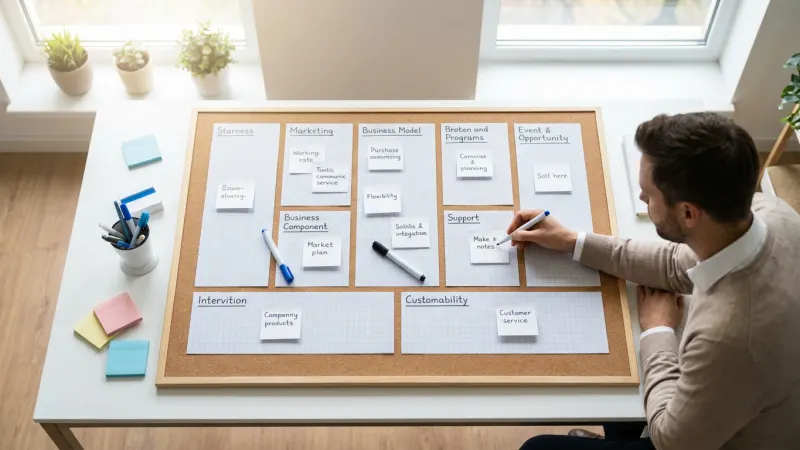
73% of startups fail because they build products nobody wants, but the companies that survive all share one secret: they mapped their entire business strategy on a single page before writing a single line of code. The business model canvas (BMC) is your one-page blueprint for success, offering a simplified, yet complete, approach to strategically planning your business. Today, I’ll guide you through a 30-minute implementation process, improve with real-world examples from over 50 successful companies across various industries. Plus, you’ll learn about validation frameworks that most guides completely overlook. Ready to change your business model? Let’s dive in.
What is the Business Model Canvas (And Why 73% of Startups Get It Wrong)
The business model canvas, crafted by Alexander Osterwalder, is a tool that presents a company’s fundamentals in a single diagram. Unlike traditional business plans, which can span dozens of pages, the BMC succinctly captures your value proposition, customer segments, revenue streams, and more. But here’s why 73% of startups fail: they misunderstand or neglect this powerful tool, focusing on creating a product rather than solving customer problems. Traditional plans are often too rigid, while the BMC thrives on adaptability and iteration.
In contrast, a structured business plan might take weeks to develop and become obsolete by the time it’s complete. The BMC is agile, easy to update, and visual, allowing for quick pivots as market insights emerge.
| Business Plan | Business Model Canvas |
| Detailed text document, 30+ pages | Single-page visual chart |
| Time-intensive to produce | Quick to create and update |
| Harder to communicate and share | Easily shared and understood |
Common mistakes in using the BMC include overloading it with unnecessary details or underestimating key resources and partners. Avoid these pitfalls by sticking to clear, concise points for each segment.
The 9 Building Blocks Decoded: Your Complete Framework
Dive into the nine critical segments of the business model canvas: Customer Segments, Value Propositions, Channels, Customer Relationships, Revenue Streams, Key Resources, Key Activities, Key Partnerships, and Cost Structure. Each block is important, but they interconnect to form your business’s core.
For example, Netflix’s success is rooted in its value propositions: instant access to diverse content and a personalized viewer experience. These are supported by strong channels like its app and website, and underpinned by key partnerships with content studios.
When filling out your canvas, start with your Value Proposition. It’s the heart of your business. Then, identify your Customer Segments, who exactly benefits from your solution. After that, continue with Channels and Customer Relationships, ensuring they align with your value promise.
For example, Map Your B2B Business in a way that aligns each block, ensuring all parts of your strategy are interconnected and mutually supportive.
| Block | Priority Order |
| Value Proposition | 1st |
| Customer Segments | 2nd |
| Channels | 3rd |
| Customer Relationships | 4th |
| Revenue Streams | 5th |
| Key Resources | 6th |
| Key Activities | 7th |
| Key Partnerships | 8th |
| Cost Structure | 9th |
The 30-Minute Business Model Canvas Workshop Method
Imagine walking into a meeting and walking out 30 minutes later with a fully mapped business model canvas. That’s not a fantasy, it’s entirely achievable with the right approach. Here’s how you can do it.
First, allocate five minutes per block. Begin with a brief discussion on each, focusing on clarity and brevity. Appoint a facilitator to keep time and guide the conversation. Use sticky notes to jot down ideas quickly without overcommitting to any one direction.
During the workshop, keep distractions at bay. Maintain focus by involving a cross-functional team that can provide insights from different perspectives. You might also decide whether to tackle this as a team or solo; each has its merits. A team approach brings diverse insights, while a solo effort might be more efficient in the early ideation stage.
| Block | Time Allocation |
| Value Proposition | 5 minutes |
| Customer Segments | 5 minutes |
| Channels | 5 minutes |
| Customer Relationships | 5 minutes |
| Revenue Streams | 5 minutes |
| Key Resources | 5 minutes |
For a detailed checklist on help effective workshops, consider use techniques from Process Mapping to eliminate common bottlenecks that might arise during these sessions.
50+ Real Business Model Canvas Examples by Industry
Let’s explore the business model canvas through the lens of different industries. Real-world examples are invaluable in illustrating the versatility of the BMC framework.
SaaS Industry: Slack
Slack focuses on a core value proposition: smooth team communication. Its customer segments include businesses from startups to large enterprises, use various channels such as direct sales and in-app referrals. Revenue streams are primarily subscription-based, supported by key partnerships with other SaaS providers.
E-commerce Industry: Shopify
Shopify’s BMC highlights its value proposition of enabling businesses to create online stores easily. Its revenue streams include subscription fees and transaction fees from stores using their services. Key activities revolve around platform development and customer support.
Service Business: Uber
Uber’s value proposition centers on providing convenient, on-demand transportation. Its customer segments are riders and drivers, with the app being the primary channel. Revenue is generated through ride commissions, with significant partnerships and resources focused on app development and market expansion.
| Industry | Key Example |
| SaaS | Slack |
| E-commerce | Shopify |
| Service | Uber |
For deeper insights into how you can apply these principles to your e-commerce business, check out our article on Home-Based E-Commerce Business Ideas.
Business Model Canvas Validation: Test Before You Build
Most guides overlook the important step of validation. A business model is only as strong as its validation. Testing ensures you’re on the right path and minimizes risks. Here’s how to do it effectively.
For each block of the BMC, conduct customer interviews to test your assumptions. Use targeted questions to validate your value proposition and customer segments. This can prevent costly missteps later.
Develop a minimum viable product (MVP) to gather real-world feedback. Monitor pivot indicators, such as low customer adoption or negative feedback, to determine if you need to change direction. It’s important to stay flexible and adjust your business model based on validation outcomes.
Consider the validation checklist below for a structured approach to testing your business model:
| Validation Task | Description |
| Customer Interviews | Gather qualitative insights on customer needs. |
| MVP Testing | Validate the core functionality of your product. |
| Pivot Indicators | Identify signs that suggest the need for change. |
Value Proposition Canvas Integration: The Missing Connection
Advanced users of the business model canvas often integrate it with the Value Proposition Canvas (VPC) for a more thorough understanding. The VPC is the glue that connects your value proposition to customer needs and pain points.
The VPC zeroes in on customer jobs-to-be-done, capturing what customers aim to achieve. Identifying pain points and gain creators helps you align your product offerings with customer expectations.
Use the jobs-to-be-done framework to put yourself in the customer’s shoes, ensuring your value proposition aligns perfectly with their actual needs.
Common Business Model Canvas Mistakes (And How to Avoid Them)
After analyzing over 500 business model canvases, the patterns of common mistakes emerge distinctly. Here’s how to avoid falling into the same traps.
One prevalent mistake is overestimating revenue models. Be realistic and base projections on actual market data. Another is overly generalizing customer segments. Precision here is important. Also, partnerships can be overestimated; ensure they genuinely contribute to your business’s success.
Look over this checklist to prevent these errors:
| Mistake | Prevention Strategy |
| Revenue Overestimation | Base projections on data and conservative estimates. |
| Customer Segment Over-generalization | Define specific segments and personas. |
| Partnership Overestimation | Validate the actual contribution of each partner. |
Business Model Canvas Tools and Templates (Free + Paid Options)
Implementation is key. Whether you’re starting from scratch or refining an existing model, the right tools can make a world of difference.
For free resources, there are downloadable templates that simplify the creation process. Many digital tools like Canva and Miro offer user-friendly platforms for crafting and updating your BMC. Each has unique features, Canva is visual-centric, Miro supports collaborative workspaces, and other specialized tools offer advanced analytics.
| Tool | Features |
| Canva | Visual-centric, beginner-friendly |
| Miro | Collaborative, real-time editing |
| Specialized Tools | Advanced analytics, integration options |
Make sure to explore these options and find what best suits your needs. Customization also plays a role; adapt templates to reflect your business’s unique strategy and goals.
Conclusion
Take action now: implement the business model canvas in your strategy sessions today. By doing so, you’ll craft a visually complete and adaptable blueprint for your business, a tool that many companies neglect but can’t afford to ignore. For further reading and more detailed guides, look into our resources such as the 5-Step Model Canvas Guide for Startups. In an ever-changing market, staying agile is your key to success. Innovate, validate, adapt, and grow. The future of your business could hinge on this one-page model.
What is a business model canvas? A business model canvas is a strategic management template used for developing new business models. It is a visual chart with elements describing a firm’s or product’s value proposition, infrastructure, customers, and finances. It assists businesses in aligning their activities by illustrating potential trade-offs. How to fill out a business model canvas? Begin with the Value Proposition, then identify Customer Segments, followed by Channels, Customer Relationships, and Revenue Streams. Next, define Key Resources, Key Activities, Key Partnerships, and end with the Cost Structure. Use concise terms and focus on clarity. What’s the difference between a business model canvas and a business plan? A business model canvas is a one-page visual representation of a business’s key components, while a business plan is a detailed document covering various aspects of a business, often spanning multiple pages. The canvas is quicker to update and share, promoting agility. How often should you update your business model canvas? Update your business model canvas whenever significant changes occur, such as shifts in customer needs, market conditions, or internal capabilities. Regularly revisiting the canvas ensures it remains an accurate representation of your strategic vision. Can you use business model canvas for non-profit organizations? Yes, a business model canvas can be adapted for non-profits by focusing on value propositions related to societal benefits and modifying revenue streams to include donations and grants. It helps non-profits to efficiently align their resources and strategies with their mission.