
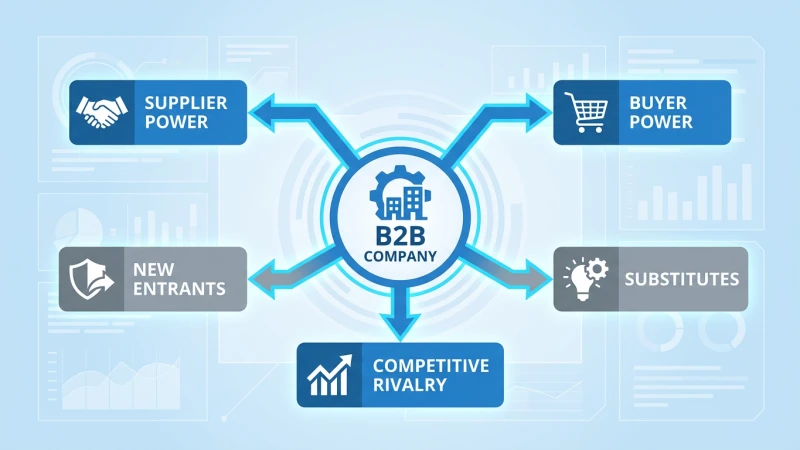
87% of B2B executives use competitive analysis frameworks incorrectly for their markets, applying B2C-focused models to complex B2B system where buyer behavior, supplier relationships, and competitive dynamics work fundamentally differently. If you’re losing revenue or valuable time because of misapplied strategies, you’re in the right place. You’ll walk away with a detailed 5-step framework for applying Porter’s Five Forces in B2B markets, turning complex market environments into clear strategic insights. Let’s dive in.
Porter’s Five Forces Model: Strategic Foundation for B2B Markets
Porter’s Five Forces Analysis is a staple in strategic planning, providing a lens to evaluate the competitive forces shaping an industry. But in B2B markets, this analysis requires some tweaking. While the original model, introduced by Michael Porter at Harvard, revolves around industry attractiveness and competitive pressure, B2B markets call for a modified approach focusing on higher complexity and deeper relationships.
In B2B settings, the stakes are higher, and the relationships are deeper. More than 50% of B2B transactions involve complex decision-making units and strategic partnerships, which aren’t common in B2C. This means that applying a B2C approach can lead to inaccuracies and missed opportunities. Below is a comparison of how these forces differ between B2B and B2C markets:
|
Force |
B2B Considerations |
B2C Considerations |
|
Supplier Power |
Long-term contracts, strategic partnerships |
Short-term transactions, price sensitivity |
|
Buyer Power |
Decision-making units, negotiation complexity |
Individual consumers, brand loyalty |
|
Competitive Rivalry |
Relationship-based, long sales cycles |
Price wars, brand differentiation |
|
Threat of New Entrants |
High entry barriers, regulatory constraints |
Low entry barriers, marketing spend |
|
Substitutes |
Custom solutions, integrated systems |
Direct product swaps, brand alternatives |
Understanding these differences is important to refining your B2B strategic planning. Let’s take a closer look at each force, starting with supplier power.
Supplier Power Analysis in B2B Markets: Beyond Simple Bargaining
Supplier power in B2B markets goes beyond basic price negotiations. It’s about strategic alignment and long-term partnership building. Most B2B transactions are not one-off purchases but rather part of a broader supply chain strategy.
In markets where supplier concentration is high, the power dynamics shift significantly. For example, if your business relies on a handful of suppliers for important components, they hold significant influence over your cost structures and supply chain efficiency. This is especially true in tech industries where specific supplies are both scarce and critical.
The key is to assess the power of suppliers using an eight-point evaluation matrix:
|
Criteria |
Importance |
|
Supplier Concentration |
High |
|
Availability of Substitute Inputs |
Low |
|
Importance of Volume to Supplier |
Medium |
|
Cost of Switching Suppliers |
High |
|
Relationship Stability |
High |
|
Supplier’s Own Brand Strength |
Medium |
|
Forward Integration Threat |
Medium |
|
Technical Expertise |
High |
Each criterion offers insights into the balance of power and helps anticipate any shifts that could impact your operations. The challenge is not just understanding these dynamics but use them to maintain a competitive advantage. Now, let’s explore the unique dynamics of B2B buyer power.
Buyer Power Dynamics: Navigating B2B Decision-Making Units
Buyer power in B2B is a labyrinth of decision-makers and influencers. Unlike B2C, where a single consumer makes a purchase, B2B buying decisions often involve multiple decision-makers. These teams, known as decision-making units (DMUs), are complex and layered.
Imagine you’re selling enterprise software. The decision isn’t solely in the hands of the CIO. It involves procurement, finance, IT, and sometimes even HR. Each of these decision-makers influences the final decision, making the buying process intricate and lengthy, often extending the sales cycle by 30% or more compared to B2C.
Here’s a step-by-step process to map B2B buyer influence:
- Identify all potential decision-makers within the DMU.
- Determine each decision-maker’s influence level and interest.
- Analyze past purchases to understand decision-making patterns.
- Engage with each decision-maker to identify key pain points and priorities.
- Develop tailored value propositions emphasizing decision-maker-specific benefits.
- Maintain ongoing relationships to anticipate future needs and preferences.
This map provides clarity on who holds the power and how best to position your offering. It shifts your strategy from simply pushing products to genuinely solving problems. Next, we’ll discuss competitive rivalry in B2B markets.
Competitive Rivalry Assessment: B2B Market Intensity Factors
In B2B markets, competitive rivalry isn’t just about who has the lowest price. It involves understanding long-term relationships, service differentiation, and the speed of competitive responses. The lengthier sales cycles in B2B, often lasting three to six months, intensify the stakes for winning contracts.
Market concentration is one key factor. A market dominated by a few large players means a more intense rivalry. The ability to differentiate based on service and product customization can provide a significant edge. For example, a B2B IT service provider may differentiate through proprietary technology that reduces client integration time by 25% compared to competitors.
Here’s a scoring framework for evaluating competitive intensity:
|
Metric |
Weight |
|
Market Share Distribution |
15% |
|
Rate of Innovation |
10% |
|
Service Differentiation |
20% |
|
Switching Costs |
15% |
|
Response Time to Competitors’ Moves |
10% |
|
Brand Loyalty |
10% |
|
Cost Efficiency |
10% |
|
Customer Relationships |
5% |
|
Product Performance |
10% |
|
Geographic Reach |
5% |
Each metric helps you evaluate your competitive positioning in the market and identifies areas for improvement. Let’s move forward to explore the threat of new entrants in B2B markets.
Threat of New Entrants: B2B Market Barriers and Entry Strategies
The threat of new entrants in B2B is mitigated by barriers that often don’t apply to B2C. These include relationship-based barriers, regulatory requirements, and substantial capital investments. In industries like healthcare or finance, compliance and regulatory hurdles alone can deter new players, safeguarding established firms.
Also, existing relationships can act as a strong deterrent. A new entrant might struggle to convince firms to switch from a trusted vendor they’ve relied on for years. Building these relationships from scratch requires significant time and resources.
Here’s a checklist to evaluate entry barriers:
|
Barrier |
Impact Level |
|
Capital Requirements |
High |
|
Economies of Scale |
Medium |
|
Brand Loyalty |
High |
|
Access to Distribution Channels |
Medium |
|
Regulatory Compliance |
High |
|
Product Differentiation |
Medium |
|
Switching Costs |
High |
|
Proprietary Technology |
Medium |
|
Network Effects |
Low |
|
Customer Loyalty Programs |
Low |
|
Supplier Relationships |
High |
|
Industry Experience |
Medium |
Assessing these barriers allows you to strategize effectively, either fortifying your position or identifying exploitable gaps as a potential new entrant. Next, let’s discuss how B2B markets handle substitutes.
Substitute Products and Services: B2B Solution Alternatives
Substitution in B2B isn’t as straightforward as in B2C. Solutions often involve bespoke products or integrated systems tailored to specific business needs. The threat of substitutes in B2B hinges on whether a competitor’s offering can provide similar functionality or cost-effectiveness.
Direct substitutes are rare. Instead, companies often face indirect substitutes, like a different technological approach or an entirely new business model. Consider cloud services replacing traditional IT infrastructures. These alternatives often come with a trade-off between cost savings and integration complexity.
Use this framework to assess the threat of substitutes:
|
Substitute Factor |
Threat Level |
|
Price-Performance Ratio |
High |
|
Innovation Disruption |
Medium |
|
Switching Costs |
High |
|
Customer Willingness to Switch |
Low |
|
Brand Identity and Loyalty |
Medium |
This analysis helps you anticipate substitution threats and adjust your product offerings to maintain competitive advantage. Now, let’s look into implementing Porter’s Five Forces Analysis in a practical setting.
Implementing Porter’s Five Forces: B2B Market Intelligence Process
Implementing Porter’s Five Forces in B2B markets involves a structured approach to data collection and analysis. It’s not a one-time effort but an ongoing process that requires constant refinement.
Begin with data collection. Use surveys, interviews, and quantitative data to understand each force’s influence on your market. For example, a decision-maker interview can unveil hidden insights about power dynamics within the decision-making unit.
Develop a 90-day project plan:
- Week 1-2: Identify key decision-makers and gather primary data.
- Week 3-4: Analyze supplier and buyer power using collected data.
- Week 5-6: Conduct competitive rivalry assessment through market research.
- Week 7-8: Evaluate threats of new entrants and substitutes with industry reports.
- Week 9-10: Synthesize findings into a complete report.
- Week 11-12: Present insights to key decision-makers and develop an action plan.
This roadmap ensures a thorough analysis that provides practical insights. For further insights on strategic planning, check out our guide on competitive analysis frameworks.
Real B2B Five Forces Analysis: SaaS Enterprise Software Case Study
Let’s walk through a real application of Porter’s Five Forces Analysis in the enterprise SaaS market. Consider a company competing in enterprise-level CRM solutions.
The supplier power is moderate due to alternative cloud infrastructure providers. Buyer power is high, with businesses making complex purchase decisions involving several departments. Competitive rivalry is intense, with major players constantly improving features. New entrants face substantial barriers due to brand loyalty and high switching costs. Substitutes are minimal, given the custom integrations required by enterprises.
Overall, this analysis highlights the importance of strengthening supplier relationships and focusing on innovation to differentiate in a competitive market. Strategic recommendations based on this analysis include investing in proprietary software features and increasing engagement with decision-making units to solidify buyer relationships.
Conclusion
To master Porter’s Five Forces in B2B markets, start applying the frameworks and processes outlined today. Assess your supplier relationships, understand your buyers, evaluate your competitors, and anticipate new entrants and substitutes. Your strategic insights will be sharper, and your competitive edge more pronounced. For further guidance, explore our articles on B2B strategic planning and competitive analysis frameworks. Prepare for a market where informed decision-making defines market winners.
What are Porter’s Five Forces? Porter’s Five Forces is a framework for analyzing the competitive forces at play in an industry: supplier power, buyer power, competitive rivalry, threat of new entrants, and threat of substitutes. It helps businesses understand the dynamics affecting their industry and strategy. How to do a Porter’s Five Forces analysis? To conduct a Porter’s Five Forces analysis, evaluate each of the five forces within your industry. Examine the power and influence of suppliers and buyers, assess competitive intensity, and identify potential threats from new entrants and substitutes. Collect data through decision-maker interviews and market research to support your assessment. How long does a Porter’s Five Forces analysis take? A thorough Porter’s Five Forces analysis typically takes 4-6 weeks, depending on the complexity of the industry and the availability of data. This includes time for planning, data collection, analysis, and implementation of insights. What data do you need for Porter’s Five Forces analysis? Key data includes supplier and buyer concentration, competitor market shares, industry growth rates, entry barriers, and substitute product availability. Primary data from decision-maker interviews and secondary data from industry reports are important for a complete analysis.