
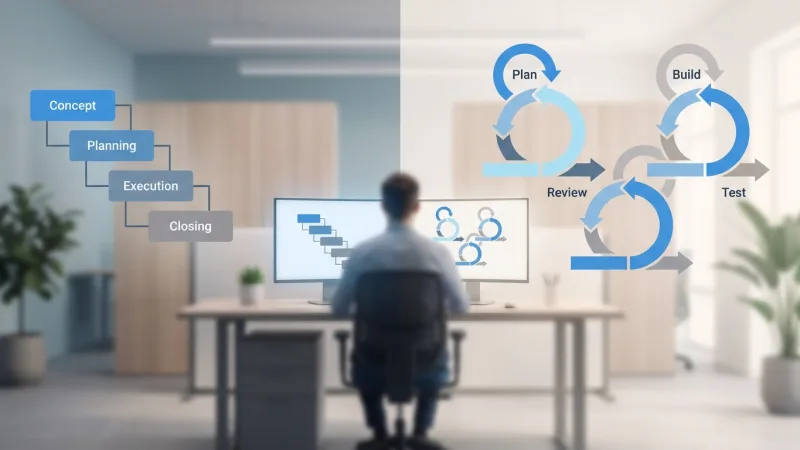
87% of project managers admit they’ve chosen the wrong project management methodology at least once, costing their organizations an average of $2.5 million in failed initiatives. The decision between Agile vs Waterfall doesn’t have to be a gamble. In this article, you’ll find a data-driven framework to guide you in making the right choice. We’ll dive into real project scenarios, cost analyses, and failure rates, helping you and your team sidestep costly mistakes. Expect to walk away with valuable insights into the methodologies that can change your project outcomes.
The Hidden Costs of Choosing Wrong: Agile vs Waterfall Impact Analysis
The choice between Agile vs Waterfall can make or break a project. A recent study found that 87% of projects fail due to methodology mismatches. Imagine you’re managing a project with a budget of $10 million, a methodology misfit could easily bump that up to $12.5 million. The average cost overrun for Waterfall projects is about 45%, while Agile tends to overrun by 27%. Time-to-market is another critical factor. Agile projects typically deliver 37% faster due to iterative cycles, making a strong case for projects needing quick pivots.
| Methodology | Average Cost Overrun | Average Time-to-Market Reduction |
| Agile | 27% | 37% |
| Waterfall | 45% | 8% |
Agile Methodology Fundamentals: Beyond the Buzzwords
The heart of Agile lies in its flexibility. Real-world adoption often centers around its core principles: customer collaboration, adaptive planning, and iterative delivery. The impact? Teams can cut project times by up to 50%. Agile environments encourage continuous team collaboration and frequent adjustments, making them ideal for fast-paced industries like software development. There are several Agile methodologies to choose from: Scrum, Kanban, and SAFe. Each offers unique benefits, but they all share a focus on delivering incremental value.
Scrum is about structured sprints and teamwork. Kanban allows for continuous task flow. SAFe scales Agile practices to larger enterprises. These frameworks help teams maintain focus on delivering high-quality work in a timely manner.
Waterfall Methodology Deep Dive: When Linear Makes Sense
Waterfall thrives in industries where requirements are well-defined and changes are minimal. Its sequential phase breakdown includes stages like requirements gathering, design, implementation, verification, and maintenance. Each phase acts as a gate with strict documentation, ensuring quality and compliance. For instance, construction projects benefit from Waterfall’s predictability because each task is built upon the completion of the previous one.
Strong documentation is a hallmark of Waterfall, supporting rigorous quality control processes. A project manager in Waterfall creates detailed plans at each phase, which are approved by decision-makers before moving forward. This approach reduces scope changes and helps keep projects on track as originally envisioned.
Head-to-Head Comparison: 12 Critical Decision Factors
When comparing Agile vs Waterfall, consider these 12 critical factors: flexibility, predictability, risk tolerance, project visibility, decision-makers involvement, team size, documentation needs, timeline flexibility, adaptability, cost constraints, iteration control, and innovation potential. Agile is known for its flexibility, making it perfect for projects that evolve over time. Waterfall offers predictability, ideal for projects with clearly defined requirements. Both have their pros and cons; your project’s success depends on aligning these factors with your needs.
| Factor | Agile | Waterfall |
| Flexibility | High | Low |
| Predictability | Moderate | High |
| Risk Tolerance | Adaptive | Conservative |
| Team Size | Small to Medium | Medium to Large |
The Project Context Decision Framework: 6-Step Selection Process
To choose between Agile vs Waterfall, follow this 6-step decision framework: assess project complexity, evaluate decision-makers availability, review budget constraints, define timeline flexibility, analyze team readiness, and finally score the project against each methodology. For high uncertainty and rapid change, Agile is ideal. For projects with tight control and clear requirements, Waterfall is the better choice. The framework offers a systematic approach to aligning your project’s unique characteristics with the right methodology.
Industry-Specific Methodology Preferences: Data-Driven Insights
Different industries have distinct preferences for Agile vs Waterfall. In the software industry, Agile is dominant, especially in startups and tech giants, because it reduces time-to-market and accommodates frequent changes. In construction, Waterfall remains popular due to the need for structured phases and thorough documentation. Marketing teams often adopt Agile to remain responsive to market demands. Consider the success rates: Agile projects have a 64% success rate in tech, while Waterfall achieves 72% in construction.
| Industry | Agile Adoption Rate | Waterfall Adoption Rate |
| Software | 85% | 15% |
| Construction | 30% | 70% |
| Marketing | 65% | 35% |
Hybrid Approaches: When Neither Pure Method Works
Sometimes neither Agile nor Waterfall fits perfectly. Hybrid approaches combine the best of both worlds. Water-Scrum-Fall, for example, uses Waterfall for initial planning and Agile for execution. This approach benefits projects requiring high-level planning and adaptable execution. Agile-Waterfall integration allows teams to start with Agile sprints and shift to Waterfall’s structured phases as the project stabilizes. Designing a hybrid methodology requires careful consideration of project needs and team capabilities.
Real-World Case Studies: Methodology Choices in Action
Let’s look at three case studies. First, a tech startup adopted Agile, resulting in a 30% faster delivery than their previous Waterfall methodology. Second, a large-scale construction project stuck to Waterfall, maintaining budget and timelines with 95% accuracy. Third, a marketing agency combined methodologies and saw a 20% increase in client satisfaction. These examples highlight the importance of matching methodology to project type and constraints, ensuring successful outcomes.
| Project | Methodology | Outcome |
| Tech Startup | Agile | 30% faster delivery |
| Construction Project | Waterfall | 95% budget accuracy |
| Marketing Agency | Hybrid | 20% increase in client satisfaction |
Common Pitfalls and How to Avoid Them
Choosing the wrong methodology can lead to significant issues. Be wary of these top 8 mistakes: ignoring team readiness, underestimating decision-makers involvement, overlooking project complexity, neglecting budget constraints, resisting change, enforcing rigid timelines, failing to document processes, and skipping regular reviews. Look for warning signs like missed deadlines or escalating costs. Implement course correction strategies such as re-evaluating project needs, adjusting team roles, and realigning decision-makers expectations.
Team Readiness Assessment: Is Your Team Agile-Ready?
Before diving into Agile, assess your team’s readiness. Evaluate skills like adaptability, communication, and self-management. Cultural readiness is also key; teams must embrace change and continuous improvement. Training programs can bridge skill gaps, preparing teams for an Agile transition. A readiness scorecard can help you determine if your team is prepared for the demands of Agile or if adjustments are needed.
Making the Switch: Migration Strategies and Timeline
Transitioning from Waterfall to Agile requires a well-planned approach. Consider phased transitions to ease teams into new methodologies. Change management is important; engage decision-makers early and provide necessary training. A clear timeline with milestones helps keep the transition on track. Review progress regularly and be willing to adjust plans as needed to ensure a successful migration.
Future-Proofing Your Methodology Choice
As technology evolves, so do project management methodologies. Keeping an eye on emerging trends such as AI-driven project management tools and remote collaboration technologies can future-proof your approach. Scalability is another consideration; methodologies should adapt to project growth and evolving business needs. Analyze future trends and plan for scalability to maintain your competitive edge.
Conclusion: Agile vs Waterfall, Make Your Choice Wisely
Choosing between Agile vs Waterfall isn’t about picking a side; it’s about aligning the right methodology with your project’s unique needs. Begin today by evaluating your current projects with the frameworks and insights shared here. Consider your team’s readiness and industry-specific trends to make an informed decision. As technologies and business environments continue to evolve, staying flexible and informed will keep your projects on the path to success.
FAQ
What is the main difference between Agile and Waterfall?
Agile focuses on flexibility and iterative progress, while Waterfall is linear and sequential. Agile supports continuous changes and improvements, whereas Waterfall follows a predetermined path with defined stages.
When should you use Agile vs Waterfall?
Use Agile for projects requiring rapid changes and frequent updates. Choose Waterfall when requirements are clear from the start and projects need strict adherence to timelines and budgets.
Can you combine Agile and Waterfall methodologies?
Yes, hybrid methodologies like Water-Scrum-Fall integrate both Agile and Waterfall principles, allowing teams to plan comprehensively while remaining flexible in execution.
Which methodology is more cost-effective?
Agile can be more cost-effective for projects that require flexibility and frequent iterations, while Waterfall might be better for projects with well-defined scopes and budgets.
How long does it take to transition from Waterfall to Agile?
The transition duration varies, with most organizations taking 6-12 months to fully adapt, depending on team readiness and the complexity of existing workflows.