
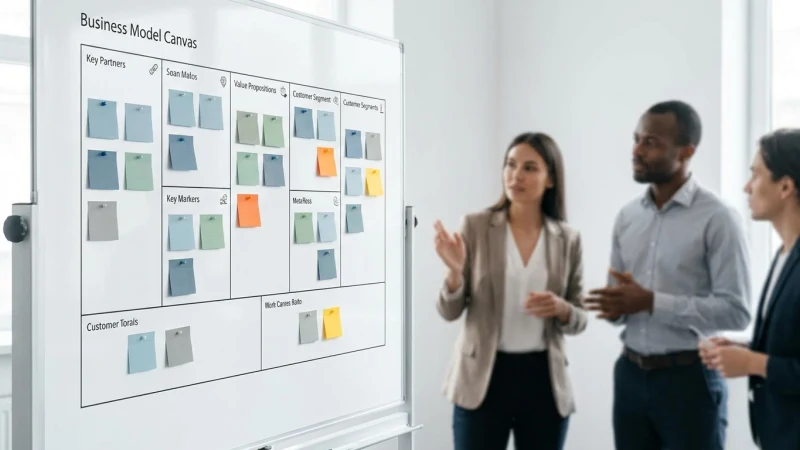
While 87% of strategic plans never get implemented, companies using the Business Model Canvas are 3x more likely to scale successfully, here’s why a single page beats a 50-page business plan every time. The problem with traditional business plans isn’t just their complexity; it’s the cognitive load they impose, often leading to paralysis by analysis. We’ll walk you through a business model canvas guide that combines traditional methodologies with real-time validation techniques, giving you a 5-step framework to craft and refine your business model effectively.
Why 87% of Strategic Plans Fail (But Business Model Canvas Doesn’t)
Strategic planning failure is rampant, with only 13% of businesses admitting their plans are executed effectively. The Business Model Canvas (BMC), however, addresses these issues head-on. Unlike traditional business plans that bog you down in lengthy content, the BMC offers a one-page solution that encourages visual thinking, clarity, and swift iterations. The best approach here is to minimize cognitive load, thus improving focus and execution.
Let’s look at how the two compare:
|
Traditional Business Plan |
Business Model Canvas |
|
50+ Pages |
1 Page |
|
High cognitive load |
Low cognitive load |
|
Long development time |
Quick iteration cycles |
|
Rarely updated |
Regularly refined |
Visual thinking isn’t just easier on the brain; it also aids in uncovering insights that might be buried in text-heavy documents. Each block of the BMC pertains to a specific aspect of your business, providing a framework for both broad and detailed planning. This makes the Business Model Canvas Guide: Map 9 Blocks on 1 Page indispensable for B2B founders eager to outmaneuver competitors.
The 9 Building Blocks: Your Complete Business Model Canvas Architecture
The Business Model Canvas consists of nine interconnected blocks that give you a 360-degree view of your business. Understanding each block is important to making informed decisions.
- Customer Segments: Define the different groups you’re creating value for. In B2B, this often includes decision-makers, influencers, and end-users. Avoid the mistake of lumping all customers together.
- Value Propositions: What unique problem are you solving? This isn’t just about features; focus on the benefits that differentiate you in the market. Use the Value Proposition Canvas for deeper integration.
- Channels: How do you deliver your value proposition? Consider both direct and indirect channels, and how each affects your customer relationships.
- Customer Relationships: Strategies to acquire, keep, and grow customers. For B2B companies, consider account management or dedicated customer success teams.
- Revenue Streams: How does your business earn money? Explore models like subscriptions or licensing, and validate with real-time testing.
- Key Resources: What assets are indispensable? In B2B, this often includes intellectual property, or critical partnerships.
- Key Activities: What actions drive your value proposition? This might involve software development or logistics improve.
- Key Partnerships: Who are your strategic allies? Look for complementary B2B partners that improve your offerings.
- Cost Structure: What are your major expenses? Identify fixed versus variable costs for a lean business model.
Common mistakes include neglecting the linkage between blocks or ignoring feedback from decision-makers. Here’s a handy checklist:
|
Block |
Checklist |
|
Customer Segments |
Identified all segment needs |
|
Value Propositions |
Defined clear benefits |
|
Channels |
Evaluated channel effectiveness |
|
Customer Relationships |
Planned retention strategies |
|
Revenue Streams |
Explored diverse revenue models |
|
Key Resources |
Listed important assets |
|
Key Activities |
Mapped critical tasks |
|
Key Partnerships |
Identified strategic partners |
|
Cost Structure |
Analyzed cost efficiency |
Focusing on these components helps you build a strong business model that can adapt to changes, something that traditional plans often fail to do. For an in-depth guide, check out our Business Model Canvas Guide: Map 9 Key Blocks in 1-3 Hours.
The 3-Phase BMC Creation Process: From Blank Canvas to Validated Model
Creating a Business Model Canvas isn’t a one-off task. It’s an iterative process that consists of three key phases: mapping, validation, and refinement.
Phase 1: Initial Mapping
Start by sketching out your initial ideas. use brainstorming techniques like mind mapping to fill out each block. The goal is to get a complete overview, even if it’s rough around the edges.
Phase 2: Validation and Testing
Once your initial canvas is laid out, the next step is testing. Use customer interviews, feedback, and A/B testing to gather real-world data. This phase is critical for testing the assumptions made during mapping.
Phase 3: Iteration and Refinement
The last phase is about refinement. Based on the data collected, make necessary adjustments to your canvas. Iterate the process until you’ve developed a model that resonates with your B2B market.
A validation checklist for each phase ensures you’re not missing important steps. This complete approach strengthens your business model, making it resilient to market fluctuations.
Real BMC Examples: 5 B2B Companies That Nailed Their Canvas
Examining real-world examples offers invaluable insights into successful strategies. Here’s how five B2B companies set themselves apart.
SaaS Company: A SaaS company focused on CRM identified unique value propositions. They use a subscription model that offered scalability and customization, making customer management effortless. Key partnerships with other software providers expanded their reach.
Consulting Firm: This firm specialized in digital change, highlighting key activities such as workshops and training sessions. Their BMC emphasized customer relationships by offering personalized consulting packages.
Manufacturing B2B: A precision engineering firm focused on quality assurance and timely delivery as core value propositions. Their channels included direct sales and industry trade shows for maximum exposure.
Platform Business: This platform integrated freelance services with companies looking for flexible talent. By focusing on customer segments like startups and SMEs, they fine-tuned their revenue streams via transaction fees.
Here’s a summary of the key success factors across these examples:
|
Company Type |
Key Success Factor |
|
SaaS |
Scalability and customization |
|
Consulting |
Personalized services |
|
Manufacturing |
Quality and timely delivery |
|
Platform |
Flexible talent integration |
These examples demonstrate the flexibility and adaptability of the Business Model Canvas in various B2B contexts. For more B2B strategy insights, check out how companies carve untapped markets.
Advanced BMC Techniques: Beyond the Basic Nine Blocks
While the basic blocks provide a strong framework, advanced techniques can offer even greater insights and strategic direction. Consider integrating the Value Proposition Canvas for a more nuanced understanding of customer needs.
Multi-sided platform adaptations are another advanced technique. These platforms often cater to two or more distinct customer segments, necessitating a tailored approach to each. system mapping extensions can identify interdependencies and external influences that could affect your business model.
Here’s an integration workflow that can guide you:
Start with your existing BMC, then layer in additional frameworks like the Value Proposition Canvas. Refine customer segments and value propositions based on new insights. The ability to iterate quickly is critical for maintaining a competitive edge in dynamic markets.
By going beyond the basics, you not only improve your current strategies but also build innovation that leads to sustainable growth. Consider our RPA implementation guide for more advanced business strategies.
Common BMC Mistakes That Kill B2B Strategies (And How to Avoid Them)
The most effective strategies are often derailed by avoidable mistakes. Here are the top seven you should watch out for:
- Ignoring customer feedback in early stages.
- Overlooking cost implications of new initiatives.
- Neglecting relationships with key partners.
- Failing to validate revenue model assumptions.
- Underestimating the importance of key activities.
- Misaligning value propositions with customer needs.
- Not revising the canvas periodically.
Red flags in each canvas section can often be spotted early with a systematic review process. Here’s a checklist to help you:
Ensure all assumptions have supporting data. Regularly update your canvas based on feedback and market changes. Quick fixes include revisiting your customer segments and aligning your value propositions accordingly.
Identifying these pitfalls early on can save you from costly revisions later. Our competitive analysis frameworks can further assist in fine-tuning your strategy.
From Canvas to Action: Implementing Your Business Model in 30 Days
Mapping out a Business Model Canvas is one thing; implementing it is another. A 30-day action plan can bridge this gap.
Week 1: Set specific KPIs for each block and begin initial testing of assumptions. Week 2: Conduct pilot runs and collect data. Week 3: Analyze results and make necessary adjustments. Week 4: Finalize strategies and prepare for full-scale implementation.
Here’s a BMC-to-OKR conversion framework:
Align your key objectives and results with each canvas block. For instance, a KPI for the ‘Customer Segments’ block could be to increase engagement by 20% in targeted niches.
Our home-based business ideas section offers inspiration for different business models.
Conclusion
The next action you should take is to start drafting your Business Model Canvas today. Use this single-page guide to get started. This visual tool is more than just a planning document; it’s a dynamic framework that evolves with your business. Embrace its dynamic nature, and you’ll find your strategy more adaptable and resilient. As business market continue to evolve, those who refine and iterate will be the ones to lead.
What is a business model canvas? The Business Model Canvas is a strategic tool used to visually outline a company’s key components, including customer segments, value propositions, and revenue streams. It’s designed for easy iteration and encourages a complete view of your business strategy on a single page. How to fill out a business model canvas? Start by defining your customer segments and corresponding value propositions. Then outline channels, customer relationships, revenue streams, key resources, activities, partnerships, and cost structure. Use input from decision-makers and real-world data to refine each section. How long does it take to complete a business model canvas? The initial draft can be completed in 1-3 hours, but refining your canvas is an ongoing process. Regular updates should follow data validation and strategic shifts, typically every few months. What’s the difference between business model canvas and business plan? A business model canvas offers a one-page overview focusing on the important building blocks of your business, while a business plan is a more detailed document covering in-depth market analysis, financial projections, and operational plans.