
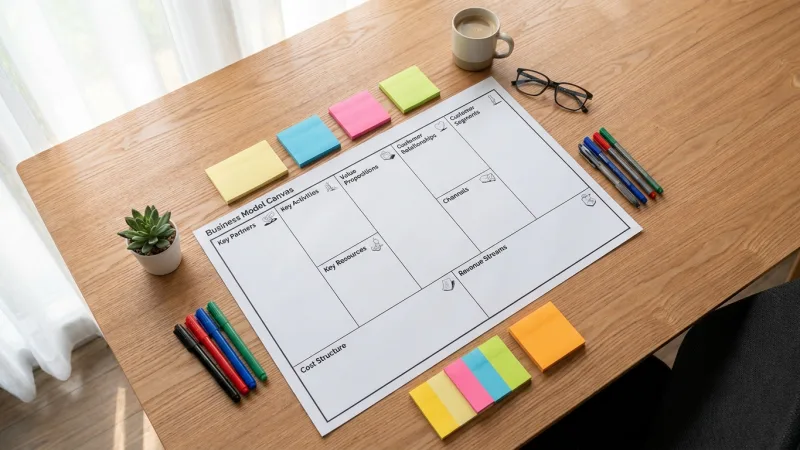
91% of startups that use a detailed business model canvas raise funding 40% faster than those relying on traditional business plans. Yet countless founders endure endless hours crafting 40-page documents only to find them collecting dust on investors’ desks. The truth? Traditional business plans often fail to deliver what investors and decision-makers really need. In this Business Model Canvas Guide, you’ll discover how to map out your B2B strategy effectively, filling each block with purpose, using real-world examples, and avoiding common pitfalls. You’ll walk away with practical insights to simplify your planning process and validation framework to ensure each section of your BMC works in harmony.
What Is the Business Model Canvas (And Why Traditional Business Plans Fail)
The Business Model Canvas (BMC) is a strategic management tool that condenses the essence of your business model onto a single page. Contrast this with the traditional business plan: a document averaging 40 pages in length, filled with analysis that rarely gets a second glance from investors. Why do these plans often fall short? They’re static, time-consuming, and quickly become outdated.
Alexander Osterwalder introduced the BMC as a simplify, dynamic alternative. A typical BMC requires only a few hours to complete, allowing for rapid iteration and testing, much needed in today’s fast-paced market. Consider a startup founder: instead of spending weeks crafting a verbose document, you could instead use the BMC to summarize your strategy, test assumptions, and pivot efficiently.
|
Aspect |
Business Plan |
Business Model Canvas |
|
Length |
30-50 pages |
1 page |
|
Time to Create |
Weeks |
Hours |
|
Adaptability |
Low |
High, due to ease of iteration |
Want a deeper dive? Check out our detailed comparison on how each approach stacks up when mapping your business strategy.
The 9 Building Blocks of the Business Model Canvas (Complete Framework)
The canvas breaks down your business model into nine key areas, each representing a different pillar of your company. They include Customer Segments, Value Propositions, Channels, Customer Relationships, Revenue Streams, Key Resources, Key Activities, Key Partnerships, and Cost Structure. Collectively, they offer a complete view of how a company intends to make money, deliver value, and sustain itself.
Imagine these blocks as interconnected pieces of a puzzle. The left side of the canvas focuses on infrastructure and efficiency, targeting the resources and activities needed to create value. Meanwhile, the right side emphasizes customers and markets. The central block, Value Propositions, acts as the bridge connecting these two elements.
Understanding how these blocks interact is important. For instance, your Value Proposition directly influences Customer Segments and vice versa. Keen to see how they fit together? Explore our in-depth guide that dives deep into each block.
Customer Segments: Identifying Your Ideal B2B Buyers (Block 1)
Identifying the right customer segments is important for your business model’s success. Unlike B2C markets, B2B segmentation involves understanding firmographic and demographic criteria, complicated further by multi-decision-makers decision-making processes. Recognizing who your true customers are can mean the difference between a successful launch and a costly failure.
Start by defining your market with firmographics: company size, industry, and lifecycle stage. For instance, a SaaS provider might target mid-sized financial institutions needing advanced analytics. Then consider demographic attributes of decision-makers, such as age and job role, to tailor your messaging.
Once you’ve identified potential segments, validation is key. Use a framework that includes conducting interviews, surveys, and using analytics tools to ensure the segment aligns with your Value Proposition. Consider a real-world SaaS company that used this strategy, mapping decision-makers and prioritizing segments based on revenue potential and strategic alignment.
For more on engaging the right audience, visit our step-by-step guide on B2B market segmentation.
Value Propositions: Crafting Offers That Sell Themselves (Block 2)
Your Value Proposition is the heart of your BMC. It’s the reason customers choose your product over another. The goal is to clearly define the unique value your business brings to the market. For B2B companies, this often revolves around specific enhancements in productivity, cost savings, or revenue generation.
Begin with the jobs-to-be-done framework. What jobs are your customers hiring your product to do? For example, a B2B data analytics firm might focus on improving data-driven decision-making for marketing teams.
Next, articulate your pain relievers and gain creators. How does your offering reduce existing pains or create new value? Quantifying this value is critical. Imagine offering a tool that cuts analysis time by 30%, translating into significant operational savings for your clients.
Test your Value Proposition by presenting it to potential customers and gathering feedback. Use a calculator to quantify the business value and refine your proposition based on real-world results. Visit our guide on value creation strategies for further insights.
Revenue Streams and Cost Structure: Building Profitable B2B Models (Blocks 1 & 9)
Establishing clear revenue streams and understanding your cost structure is important for any B2B business. Identify whether your revenue comes from recurring sources, like subscription models, or one-time transactions.
B2B pricing strategies often include tiered pricing, usage-based models, or enterprise pricing. For instance, a cloud service provider might offer flexible pricing based on data consumption levels, ensuring scalability for its clients.
|
Revenue Model |
Example |
Use Case |
|
Subscription |
SaaS platforms |
Ongoing access to software |
|
Licensing |
Enterprise software |
Perpetual software rights |
|
Services |
Consulting firms |
Custom project-based work |
Your cost structure should align with your key resources, activities, and partnerships. For effective cost management, use a sales metrics framework to calculate the unit economics of each value proposition. Analyze your cost structure’s impact on profitability, ensuring you improve where necessary.
Explore our complete guide on monetization strategies to build a sustainable B2B model.
Distribution Channels and Customer Relationships (Blocks 3 & 4)
Navigating the complex B2B sales market requires an understanding of distribution channels and customer relationship strategies. Direct channels might involve a sales team, while partner channels could include resellers or affiliates.
Mapping the customer journey is important. A B2B sales cycle is often longer and involves multiple touchpoints. Consider a software firm needing to engage IT teams, finance departments, and end-users across different stages.
Customer relationships are equally critical. Establishing a strong customer success strategy not only reduces churn but also encourages upsell opportunities. Effective relationship management requires aligning your sales and support functions, ensuring consistent value delivery.
Discover more about balancing channels and relationships in our complete analysis.
Key Resources, Activities & Partnerships (Blocks 7, 8 & 5)
Your operational strength hinges on efficiently managing key resources, activities, and partnerships. Prioritizing resources involves distinguishing between core and non-core elements. For a SaaS company, core resources might include talent, technology, and IP, while non-core resources could be outsourced.
Strategically evaluate partnerships to amplify your reach and save costs. Use a make vs. buy decision tree to determine which activities to keep in-house and which to partner for.
A partnership ROI calculator can help evaluate the benefits versus the costs of partnerships. Ensure all partnerships align with your strategic goals and provide clear mutual benefits.
Learn more about improve operations in our resource management guide.
Business Model Canvas Template: Step-by-Step Implementation Guide
To put your BMC into action, follow a structured roadmap. Start with a 30-minute workshop format, engaging your team to brainstorm and fill out each block collaboratively. This approach not only ensures diverse perspectives but also promotes team alignment.
Validation checkpoints allow you to test each block before full implementation. For example, pilot your distribution channel strategy on a small scale, assess its effectiveness, and iterate based on feedback. Common pitfalls include overcomplicating the value proposition or underestimating channel conflicts.
Regularly revisit and refine your business model to adapt to market changes. The iteration process is important for maintaining relevance and competitive advantage. Explore an in-depth walkthrough with a real company case study by visiting our implementation guide.
Conclusion
Now it’s time for action: download our BMC template and start mapping your business today. Remember, a well-crafted Business Model Canvas is your roadmap to strategic clarity and investor confidence. As market conditions evolve, so should your business model. Stay ahead by iterating and refining your canvas regularly. Ready to change your planning process? Start now and pave the way to faster growth and success.
FAQ
What is a business model canvas?
A business model canvas is a simplified, one-page business planning tool that outlines the key elements of a business. Originally created by Alexander Osterwalder, it’s designed to help startups and established companies visualize, design, and innovate their business models efficiently.
How to fill out a business model canvas?
Begin by identifying your customer segments and value propositions, then move to channels and customer relationships. Next, define your revenue streams and cost structure. Lastly, outline key resources, activities, and partnerships. Use real-world data and validate each step to ensure alignment with your strategic goals.
What’s the difference between business model canvas and business plan?
A business model canvas is a concise, visual summary of a business, whereas a business plan is a detailed document outlining various components in depth. The canvas is flexible, quick to create, and ideal for iterative development, while a business plan is complete and used for formal documentation.
How long does it take to complete a business model canvas?
Completing a business model canvas can take anywhere from an hour to a few days, depending on the complexity of the business and the level of detail required. The process is collaborative and can be expedited by using a workshop format to gather input from various decision-makers.