
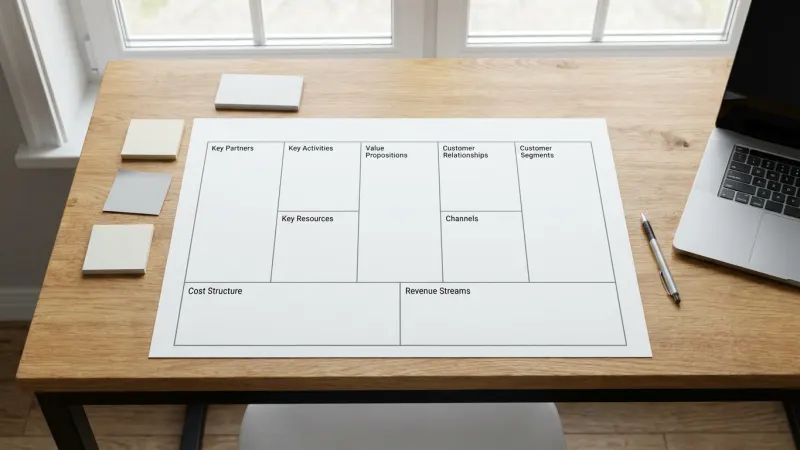
73% of entrepreneurs fill out their business model canvas in the wrong order, starting with customer segments instead of the value proposition. This mistake often leads to startups failing before they even launch. Misaligned priorities can derail your entire business strategy. Get it right from the start with our complete business model canvas guide, which promises a block-by-block framework with real-world examples and practical insights to ensure your startup doesn’t fall into the same trap.
What Is the Business Model Canvas (And Why 73% of Startups Use It Wrong)
The Business Model Canvas (BMC), developed by Alexander Osterwalder, is a strategic tool that allows you to visualize and describe your business model on a single page. However, many startups fill it out incorrectly by starting with the customer segments instead of the value proposition, leading to misaligned business goals and product-market fit issues.
Understanding the 9 building blocks can prevent this common pitfall. They are: Value Proposition, Customer Segments, Channels, Customer Relationships, Revenue Streams, Key Resources, Key Activities, Key Partnerships, and Cost Structure. According to a survey, 42% of startups fail due to a lack of market need, which could be mitigated by correctly aligning your value proposition from the start.
Common Mistakes in Filling Out the BMC
One prevalent error is overloading the BMC with too much detail, which can obscure your core strategy. Another is ignoring the relationships between blocks. For example, your channels and customer relationships must support your value proposition, not contradict it.
The 9 Building Blocks: Your Complete Fill-Out Framework
Let’s dive into each of the nine blocks with specific templates and prompts to guide your completion process.
1. Value Proposition
This is the heart of your BMC and should be filled out first. Ask yourself: What unique value do you bring to the table? How do you solve your customer’s problems?
2. Customer Segments
Who are you creating value for? Identify primary and secondary target customers to ensure your offerings are aligned with their needs.
3. Channels
Determine how you will deliver your value proposition to your customers. Will it be through an online platform or direct sales?
4. Customer Relationships
What type of relationship does each customer segment expect you to establish? Is it personal, automated, or a mix of both?
5. Revenue Streams
Identify how your business will make money. This could be through direct sales, subscriptions, or licensing fees.
6. Key Resources
List the assets required to deliver your value proposition. These could be physical, intellectual, human, or financial resources.
7. Key Activities
What important actions must your business take to deliver your value proposition? These might include production, problem solving, or networking.
8. Key Partnerships
Identify external companies or suppliers you need to work with to achieve your goals. Partnerships can be important, especially for startups.
9. Cost Structure
Outline the costs involved in operating your business model. Are they fixed, variable, or a combination of both?
|
Building Block |
Key Questions |
|
Value Proposition |
What unique value do we offer? Which customer problems are we solving? |
|
Customer Segments |
Who are our most important customers? What are their needs? |
|
Channels |
How do we reach and deliver value to our customers? |
|
Customer Relationships |
What type of relationship do our customers expect us to establish? |
|
Revenue Streams |
How do we make money from our value propositions? |
|
Key Resources |
What assets are important to delivering our value proposition? |
|
Key Activities |
What key activities do we need to perform to deliver our value? |
|
Key Partnerships |
Who are our key partners? How do they complement our resources? |
|
Cost Structure |
What are the major costs inherent in our business model? |
Real Business Model Canvas Examples (SaaS, E-commerce, Service)
Here’s how the BMC can be applied across different industries, each with its own completed example.
SaaS Startup Example
Imagine a SaaS offering that manages customer data analytics for other businesses. The value proposition might focus on providing practical insights that drive sales efficiency.
E-commerce Business Example
An e-commerce company might focus on unique product offerings that are not available on other platforms. Their channels might include both online and physical pop-ups to reach diverse customer segments.
Service-Based Business Model
Consider a consultancy that supports emerging startups. The key partnerships here might include financial advisors and legal experts to provide complete services.
|
Industry |
Key Differentiator |
Example Insight |
|
SaaS |
Data analytics |
Automated insights reduce analysis time by 30% |
|
E-commerce |
Exclusive products |
Dual-channel approach increased sales by 20% |
|
Service |
complete support |
Bundled services increased client retention by 15% |
Value Proposition Canvas: The Critical Deep-Dive Component
The Value Proposition Canvas is an important tool that complements the BMC, focusing deeply on how your products or services satisfy customer needs. It involves mapping out customer jobs, pains, and gains, and aligning them with your products’ features.
Start by identifying the customer jobs, or tasks your customers are trying to complete. Next, list their pains, then how your product or service alleviates these pains, and finally, highlight how it creates gains for them.
Step-by-Step Mapping Process
1. Define the customer profile by listing customer jobs, pains, and gains.
2. Create the value map with your product’s pain relievers and gain creators.
3. Ensure a strong alignment between the customer profile and value map for effective process mapping.
BMC Template Resources and Tools (Free Downloads Included)
Finding the right tools and resources to create your BMC can greatly improve your strategic planning. Here are some top recommendations:
Downloadable Templates
Access free templates designed for easy customization. These can be printed or used digitally for team collaborations.
Digital Tool Recommendations
Consider software solutions that allow for real-time collaboration, such as platforms with integrated e-commerce business ideas and analytics.
|
Tool |
Best For |
Features |
|
Collaborative Canvas |
Remote teams |
Real-time updates, multiple users |
|
Printable Templates |
Workshops |
High customization, easy sharing |
|
Presentation Software |
Investor pitches |
Visual aids, integration capabilities |
Common Business Model Canvas Mistakes (And How to Fix Them)
Avoid common pitfalls with your BMC by recognizing and correcting these frequent mistakes.
Top 7 BMC Mistakes
- Ignoring the value proposition-customer segment alignment.
- Overlooking key partnerships or resources.
- Failing to update the BMC regularly with new data.
- Not aligning revenue streams with cost structures.
- Creating vague customer segments.
- Ignoring competitive analysis.
- Overcomplicating the canvas with unnecessary details.
These mistakes often manifest as disjointed strategies that fail to deliver intended results.
Validation Checkpoints
Regularly revisit your BMC to ensure alignment with business goals and market changes. Use customer feedback as a validation measure to iterate your business ideas effectively.
From Canvas to Execution: Next Steps After Completing Your BMC
Completing your BMC is only the first step toward business success. Implementing it efficiently is where real challenges begin.
Business Plan Integration
Integrate your BMC insights into a detailed business plan that guides execution, aligning with investor expectations and operational needs.
Investor Presentation Tips
When presenting your model to investors, focus on the value proposition, market opportunity, and financial forecast. Visual data and clear narratives can make your pitch more compelling.
Testing and Validation Methods
Conduct market tests with real customers to validate assumptions. Use A/B testing and customer surveys as part of your validation framework.
Conclusion
Now that you’ve understood the Business Model Canvas guide, take action today by reviewing and updating your BMC. Ensure that your value proposition aligns perfectly with customer needs to drive success. For further insights, explore our guides on eliminating operational bottlenecks and e-commerce business ideas. It’s time to turn your plans into reality, paving the way for sustainable growth and success.
What is a business model canvas? A business model canvas is a strategic template for visualizing a company’s value proposition, infrastructure, customers, and finances on a single page. It allows teams to understand and align their business activities with real market needs, improving strategic planning and communication. How to fill out a business model canvas? Start with the value proposition, then identify customer segments, and progressively fill in channels, customer relationships, revenue streams, key resources, key activities, key partnerships, and cost structure. This order ensures a logical flow that aligns with your business goals. What’s the difference between business model canvas and value proposition canvas? The business model canvas outlines the overall business structure, while the value proposition canvas focuses on aligning product offerings with customer needs. The latter dives deeper into customer jobs, pains, and gains, ensuring the product effectively meets market demand. How long should it take to complete a business model canvas? Completing a business model canvas should take anywhere from a few hours to several days, depending on the complexity of your business. The key is to iterate and refine regularly as new insights and data become available, ensuring it remains aligned with market dynamics.