
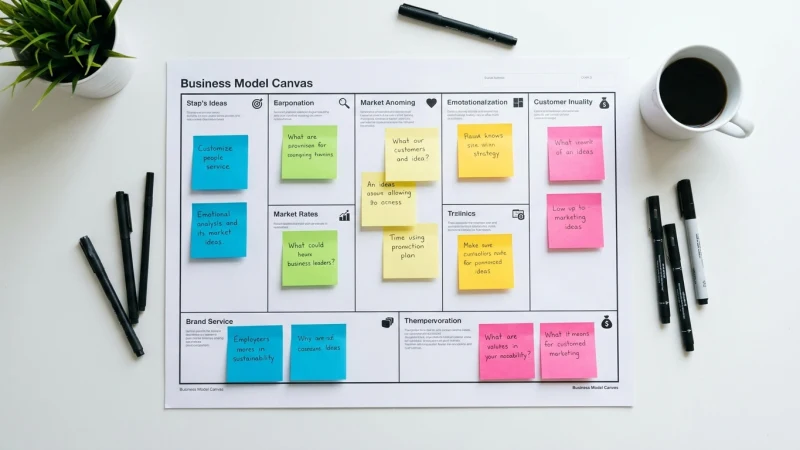
73% of businesses that spend more than six months working on their business model canvas never launch. That’s right, stagnant planning can derail entrepreneurial dreams. In this guide, you’ll learn how to craft a validated, million-dollar strategy in just 90 minutes using the business model canvas. We’ll go through a detailed business model canvas guide, equipping you with time allocations, validation frameworks, and iterative improvement processes for each canvas section.
The 90-Minute Business Model Canvas Framework: Why Speed Matters
Did you know 87% of startups fail due to lack of market validation, not poor execution? This is where the business model canvas comes in, not as just a documentation tool but as a rapid validation instrument. With a time-boxed approach, you prevent analysis paralysis and focus on what really matters: practical insights.
| Canvas Section | Time Allocation (Minutes) |
| Key Partners | 10 |
| Key Activities | 10 |
| Key Resources | 10 |
| Value Propositions | 15 |
| Customer Relationships | 10 |
| Channels | 10 |
| Customer Segments | 10 |
| Cost Structure | 10 |
| Revenue Streams | 15 |
Our approach breaks down into three phases: mapping, gathering, and iterating. Interestingly, startups that embrace rapid planning can see a 42% higher chance of securing funding compared to those trapped in prolonged planning phases.
Process mapping isn’t just for operations; it can slash your planning time by 40% too.
The 9 Building Blocks: Your Business DNA Decoded
Imagine your business as a living organism, with the business model canvas as its DNA. This single-page template helps you dissect nine important components that interconnect to form a thriving system. Each block directly influences your revenue generation strategy, making their interdependencies important to understand.
| Block | Common Mistake | Revenue Impact Score |
| Key Partners | Over-relying on a single partnership | 7/10 |
| Key Activities | Failing to prioritize core activities | 8/10 |
| Key Resources | Underestimating resource requirements | 6/10 |
| Value Propositions | Being too generic | 9/10 |
| Customer Relationships | Ignoring customer feedback loops | 7/10 |
| Channels | Relying on one marketing channel | 6/10 |
| Customer Segments | Targeting too broad an audience | 8/10 |
| Cost Structure | Ignoring variable costs | 5/10 |
| Revenue Streams | Relying on a single revenue stream | 10/10 |
Each block has a specific function but is part of an interconnected whole. A common oversight is treating these elements in isolation rather than considering their influence on customer value and operational efficiency.
Value Proposition Canvas Integration: The $10M Mistake Most Make
Failing to articulate a compelling value proposition is where 73% of businesses falter. Enter the Value Proposition Canvas (VPC), a pivotal component that, when integrated with the Business Model Canvas (BMC), can dramatically improve your market fit.
The Jobs-to-be-Done framework can play a important role here. It focuses on the customer’s desired outcomes, aligning your offerings with tangible benefits. A smooth integration ensures your value proposition resonates deeply with your target audience.
Conducting customer interviews is invaluable for validation. Use these questions: “What jobs are you trying to get done?” and “What are your biggest pain points?” Listening here can prevent costly missteps.
The 3-Phase Canvas Completion System
Time to translate theory into practice. Our 3-phase system ensures smooth execution and iteration for your business model canvas, with precise deliverables and time constraints.
- Phase 1: Assumption Mapping (30 mins) – List your core assumptions about each canvas block. Challenge each one critically.
- Phase 2: Evidence Gathering (45 mins) – Collect data and feedback from customers, market reports, and competitor analysis to validate or refute assumptions.
- Phase 3: Iteration Planning (15 mins) – Determine necessary pivots and adjustments based on evidence collected. Adjust your canvas accordingly.
Success in this process requires clear validation criteria. For instance, a startup might set a threshold of 70% positive customer feedback to affirm a value proposition assumption.
Canvas Validation: From Assumptions to Million-Dollar Insights
Testing assumptions is where many competitors drop the ball. But not you. You’ll be armed with five validation experiments for each canvas block, ensuring ironclad insights for your business.
Consider an experiment like A/B testing your pricing models with actual customers. Or perhaps a prototype demonstration to gather real-time feedback. Here’s where you use minimum viable validation criteria, like achieving 100 sign-ups within a week, to determine the direction of your strategy.
Pivoting isn’t failure. It’s a strategic redirection, often based on red flags such as unexpected market shifts, declining engagement metrics, or overwhelming customer feedback against current strategies.
Industry-Specific Canvas Adaptations: SaaS, E-commerce, and Services
Not all business models are created equal. Tailoring your canvas to industry specifics can make the difference between soaring success and mediocrity.
| Industry | Key Adaptation | Real-World Example |
| SaaS | Focus on subscription models and lifetime customer value | A software company doubling ARR by revising its pricing tiers |
| E-commerce | Emphasize on logistical partnerships and customer service | An online store reducing return rates by 30% with improved UX |
| Services | Improve cost structure through strategic outsourcing | A consultancy boosting margins by 20% by use gig workers |
For a deeper dive, see these e-commerce insights that directly feed into these frameworks.
Canvas Evolution: The Quarterly Review System That Scales
Your business isn’t static. Nor should your business model canvas be. Implement a quarterly review system to keep your canvas relevant and reflective of your growth trajectory.
Adopt a quarterly canvas health check methodology. Assess the relevance of each block, making data-driven adjustments. This process aligns the team and sharpens your competitive edge.
Future-proofing includes growth stage adaptations and establishing communication protocols that ensure every team member knows the plan, and their role in it.
Conclusion
Ready to accelerate your business strategy with the business model canvas? Start your 90-minute session today and change assumptions into practical insights with a clear, validated path to market success. Dive deeper into how to map your B2B business and use these powerful tools to scale your venture effectively.
FAQ
What is a business model canvas?
A business model canvas is a strategic management tool that allows you to visualize and analyze your business model on a single page. It help understanding, discussion, and innovation by breaking down your business into nine important components.
How to fill out a business model canvas?
Start by identifying your key partners, activities, and resources, followed by your value propositions, customer relationships, channels, and customer segments. Finally, define your cost structure and revenue streams, ensuring each section interconnects and supports your business objectives.
How long does it take to complete a business model canvas?
By following our guide, you can complete your business model canvas in about 90 minutes. This includes a structured approach with time allocated to each section, ensuring effective and efficient planning without over-analysis.
What’s the difference between business model canvas and value proposition canvas?
The business model canvas provides a complete view of your business model, while the value proposition canvas focuses specifically on the relationship between your customers’ needs and your products/services. Both are important, but the VPC offers a deeper dive into customer value alignment.