
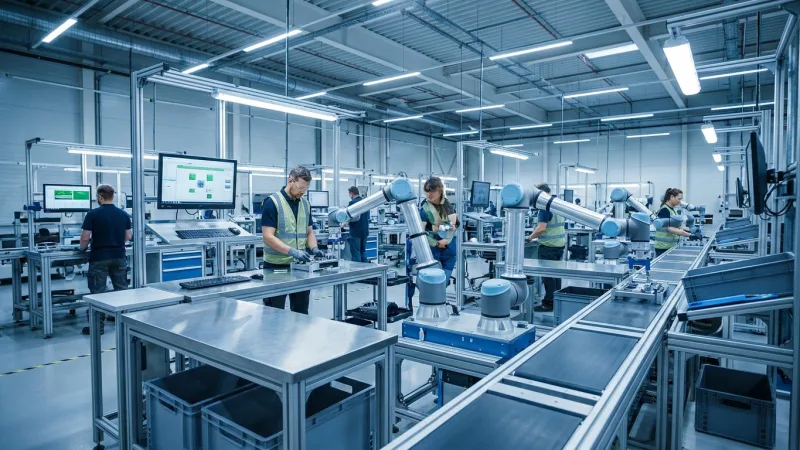
While 67% of manufacturers planned to automate by 2025, the companies actually winning in 2024 discovered something unexpected: the biggest competitive advantage isn’t choosing between humans and machines, it’s architecting the perfect collaboration between them. This is the defining moment for manufacturing business trends. As revenue slips through inefficiencies and competitors capitalize on technological advancements, leaders must understand this hybrid approach to thrive. You’ll leave with a six-step framework to integrate nearshoring and automation effectively.
The Manufacturing Renaissance: Why 2024 Marks the Industry Inflection Point
Manufacturing is witnessing a renaissance in 2024, with 73% of manufacturers reshoring operations. This shift is economically significant, manufacturing GDP growth is outpacing services for the first time since 2010. The industry’s change is fueled by a 340% increase in investment in automation since 2020. We’re standing at an industry inflection point where old models are being replaced by new strategies.
Imagine your production line adopting automation technologies, reducing lead times by 50%. This isn’t just theory. In 2024, investments are producing tangible results. Manufacturers embracing automation are seeing their operational costs drop significantly. The reason? A strong assembly of both high-tech machines and skilled human operators.
The catalyst for much of this change lies in policy shifts that incentivize reshoring. For instance, tax breaks introduced in 2023 for companies use local labor markets have encouraged many to reconsider their global footprints. This timeline of policy changes has positioned 2024 as a critical year for manufacturing leaders to redefine their strategies.
The best approach for you? Use these insights to stay ahead. Your next move might be reshoring production lines closer to your customer base to tap into these economic advantages.
Nearshoring vs Offshoring: The New Manufacturing Geography Framework
The debate between nearshoring and offshoring isn’t just about cost anymore. It’s a complex decision involving a total cost of ownership (TCO) calculator, risk-adjusted ROI models, and regional capability mapping. Manufacturing business trends in 2024 demand a strategic framework for location decisions.
Picture this scenario: A company evaluates regional capabilities and finds that nearshoring could reduce supply chain disruptions by 30%. By use an interactive decision matrix, you can assess factors beyond labor costs. This matrix considers logistics, geopolitical stability, local expertise, and proximity to markets.
| Company | Location Strategy | Outcomes |
| Company A | Nearshoring to Mexico | 30% reduction in logistics costs |
| Company B | Offshoring to China | 20% lower labor costs but increased tariffs |
| Company C | Hybrid approach with multiple sites | Diversified risk and stable supply chain |
Using case studies like “Nearshoring vs Offshoring: TCO Framework & Decision Matrix”, you can pinpoint the best location strategy. This tailored framework helps you assess each region’s potential and align it with your operational goals.
Smart Manufacturing Trends: Beyond Industry 4.0 Buzzwords
Everyone’s talking about Industry 4.0, but what’s the real deal? The manufacturing business trends of 2024 show that the buzz fades quickly without a clear ROI. The true measure of success is the payback period of automation investments, which varies across technologies.
Consider these figures: while some companies report breaking even on robotics in 18 months, others struggle with integration costs, extending payback to over 3 years. The devil’s in the details, implementation challenges, such as aligning legacy systems with new technologies, often get glossed over.
| Technology | Average ROI Period | Key Challenges |
| Robotics | 18-24 months | Integration with existing systems |
| AI and Machine Learning | 24-36 months | Data quality and availability |
| IoT Sensors | 12-18 months | Network stability |
| 3D Printing | 24-30 months | Material cost and variety |
| Cloud Manufacturing | 12-24 months | Cybersecurity |
| Advanced Analytics | 18-24 months | Skills gap in data analysis |
Understanding these timelines helps you plot an effective technology adoption roadmap. A detailed roadmap might suggest focusing first on technologies with quicker paybacks, then gradually building a more sophisticated system. For exact steps, explore “Process Mapping: Eliminate 40% of Operational Bottlenecks”.
The Hybrid Manufacturing Model: Combining Human Expertise with Automated Precision
The future isn’t fully automated; it’s hybrid. This model balances machines’ precision with human creativity, leading to increased output and workforce growth. Manufacturing business trends show that combining automation with strategic human roles improve operations.
Jobs aren’t being wiped out; they’re shifting. In fact, some companies have increased their workforce by 10% while doubling output, a near-perfect human-machine collaboration. This optimal balance varies by process type, but often benefits from a 70:30 machine-to-human ratio.
Consider a company that integrated cobots on its assembly line, cutting defect rates by 40% while training human operators for intricate quality control tasks. The result? A 200% increase in output and improve product quality. This combination exemplifies “Entrepreneurial Businesses: Seizing Opportunities in 2024”.
Manufacturing Strategy Playbook: 5 Business Models Winning in 2024
To thrive in 2024, manufacturers are embracing new business models. These include mass customization, distributed manufacturing networks, and Manufacturing-as-a-Service (MaaS). Each model offers unique profitability and scalability advantages.
Mass customization, for example, allows personalized production at economies-of-scale pricing. Companies using distributed networks achieve faster market responses by localizing production facilities. MaaS is emerging as a flexible model that reduces capital investment and operational risks.
| Business Model | Profit Margin | Scalability | Key Benefit |
| Mass Customization | 30-40% | High | Personalization at scale |
| Distributed Manufacturing | 25-35% | Medium-High | Local responsiveness |
| Manufacturing-as-a-Service | 20-30% | High | Reduced capital expenditure |
The change process for each model involves specific steps. Mass customization, for example, starts with modular design principles and evolves with advanced digital interfaces. Discover precise steps to implement these models in “7-Step Competitive Analysis Frameworks for …”.
Supply Chain Resilience: Building Anti-Fragile Manufacturing Networks
In 2024, supply chain resilience tops the list of manufacturing business trends. Building anti-fragile networks involves strategic supplier diversification and inventory improve. Manufacturers invest in real-time visibility solutions that provide unparalleled insights.
A supplier diversification formula, for instance, might suggest a 70-20-10 approach: 70% reliable incumbents, 20% strategic partnerships, and 10% exploratory vendors. This improve supply chain resilience while mitigating risks.
Inventory improve in uncertain times means use advanced analytics to find balance. Real-time visibility tools offer up-to-the-minute data, reducing buffer stock by 25%. Learn more about visibility solutions and their ROI at “The Power of B2B Influencer Marketing”.
Measuring Success: KPIs That Matter in Modern Manufacturing
The evolution of manufacturing business trends demands a new set of KPIs. Traditional metrics like Overall Equipment Effectiveness (OEE) fall short in capturing digital change value. In 2024, metrics go beyond productivity to include customer satisfaction and sustainability.
Modern dashboards should track metrics like flexible production capabilities, which correlate with a 20% increase in customer satisfaction. Sustainability ROI is equally critical; companies tracking carbon footprints see improved brand perception and compliance benefits.
| Metric | Significance | Industry Benchmark |
| Flexible Production Capacity | Customer satisfaction correlation | 15-20% |
| Sustainability ROI | Brand and compliance benefits | 10-15% |
| Real-Time Data use | Operational efficiency | 25% |
Implement these metrics with a modern dashboard template to stay competitive. Benchmarking against industry leaders ensures your operations align with dynamic standards.
Conclusion: Embrace the Hybrid Model
Your next step is clear: start crafting a hybrid manufacturing model today. Blend human expertise with automation to capture untapped market opportunities. Dive into these strategies to improve your operations: “Entrepreneurial Businesses: Seizing Opportunities in 2024”, “The Power of B2B Influencer Marketing”. The future of manufacturing is not a distant horizon, it’s unfolding now.
How is manufacturing changing in 2024? Manufacturing in 2024 is marked by a shift towards hybrid models that balance automation with skilled human roles. This era sees a 73% increase in reshoring and a rapid uptick in automation investments, fundamentally change production processes. What is smart manufacturing and why does it matter? Smart manufacturing integrates advanced technologies like AI, IoT, and robotics to improve efficiency and product quality. It’s important because it reduces lead times by up to 50% and helps manufacturers respond swiftly to market changes. Should manufacturers choose nearshoring or automation first? The best strategy combines both. Nearshoring reduces supply chain risks, while automation improve efficiency. Evaluating your specific needs through a TCO calculator and risk-adjusted ROI models guides this decision. What are the biggest manufacturing business trends for 2024? Key trends include hybrid manufacturing models, nearshoring, smart manufacturing technologies, and supply chain resilience. These focus on combining automation with strategic human input to increase competitiveness.